CHI 97 Electronic Publications: Design Briefings
Designing a Graphical User Interface for Healthcare Workers in Rural India
Sally Grisedale
Apple Research Labs
Apple Computer, Inc.
1 Infinite Loop, MS 301-3J
Cupertino, CA 95014
408 974-0731
sallyg@taurus.apple.com
Mike Graves
Apple Research Labs
Apple Computer, Inc.
1 Infinite Loop, MS 301-3E
Cupertino, CA 95014
408 974-2756
mgraves@apple.com
Alexander Grünsteidl
Apple Research Labs
Apple Computer, Inc.
1 Infinite Loop, MS 301-3E
Cupertino, CA 95014
408 974-7438
agrun@taurus.apple.com
ABSTRACT
This paper describes the research and development of an interface for a
mobile computing device to be used by Auxiliary Nurse Midwives (ANMs) in
rural India. We describe the insights of the team from Apple Research Lab
(ARL), who have had the privilege of working in a very different culture
from the ones they are used to. We show how our observations of the healthcare
workers performing their caring and administrative functions informed the
design of the user interface. We illustrate how we developed the graphical
language, navigational structure and data entry techniques. We provide a
summary of the feedback we received from early field trials and some thoughts
on the appropriateness of our approach to design in this environment.
KEYWORDS
Human interface design, mobile computing, pen input, soft keyboard, Newton
MessagePad, rapid prototyping, India, Rajasthan, Ajmer, Auxiliary Nurse
Midwife, healthcare, family welfare.
© Copyright ACM 1997
INTRODUCTION
This morning I am following Padma, the local nurse midwife, on her house
calls in Narwar, a farming village in Rajasthan. It is a hot dry day, and
the local traffic, consisting of a few stray cattle and bristly pigs, lie
slumped in troughs of dust trying to keep cool.
We come to the gate of the Sharma household and are greeted by three women
who welcome us. "Namaste" they say, and adjust their veils. The
yard outside the house is the center of communal activity. It is formed
from compacted earth and adorned with chalk drawings. Blankets are brought
for us to sit on. Water is served in metal cups, drawn from a ceramic urn
at the side of the house. The women of the household came to live at this
house as brides of the Sharma men. Three generations of women are living
in the house, each the mother in law of the other.
Today, Padma is performing a routine post natal examination on the newest
member of the family, baby Rao, whom she delivered three months ago. Padma
reaches into her bag to consult her diary, which she keeps close by her.
She talks with the women about Rao, and lays him on a low wooden bed to
take a closer look. He has black hair and dark eyes, and on his forehead
a crescent moon has been drawn, to protect him from the spirits.
A group of cattle wander into the yard - it is their lunch time, and the
women go and tend to them. Padma writes up her notes in a diary. The women
return from their chore and sing a song for me. It is a lament about the
fate of a young bride who comes to a new household and is ill treated by
her new mother in law. She pleads with her husband, ". . . husband
I love you more dearly than the jewelry around my neck, please protect me
from your family". [2] Diary entry, 23rd March 1995.
THE INDIA HEALTHCARE PROJECT
Into this environment Apple Computer Inc., and the Government of India wanted
to introduce Newton MessagePad technology. The goal was to develop and deploy
a Newton-based data-capture and viewing prototype, which would provide contextual
performance support and health education information to healthcare workers
like Padma.
The Opportunities the Project Offered
For Apple Computer Inc., this was a huge opportunity to learn how technology
could be designed for an emerging market. It provided a case study for learning
about developing solutions for "low-tech" circumstances, to be
used by people with minimal exposure to computer based tools, and to apply
this understanding to designing products.
For the Government of India (GOI), the Secretary for Health wanted to improve
the current administration by improving the accuracy of information collected
about the nation's health through its ambitious provision of free basic
healthcare for all. The particular program we worked on was called Health
and Family Welfare (H&FW), and it focused on the collection of information
about the rural population in India by the ANMs. Figure 1 shows the hierarchy
of the rural healthcare administration from minister to ANM.

Figure 1: Healthcare administration hierarchy and number of people provided
for.
OVERVIEW OF THE HEALTHCARE SYSTEM
The rural population of India is about 630 million people spread among 32
states [1]. The program is administered locally from districts within each
state. Further administrative blocks and sectors exist within the district
to ensure geographic availability of some basic services across the country.
The boundaries and sites of health centers within the district of Ajmer
are shown in Figure 2.
FORMING A TEAM
The team from ARL made their first field visit to India in 1994 to observe
and collect information about the healthcare workers. The team grew from
2 to 6 people in two years. The team is international and has combined expertise
in system architecture, user studies, human interface design, programming
and management. We had additional help from experts in healthcare, videography,
travel, administration and translation within India.
The site for our field visits was designated by the Secretary for Health
and Family Welfare. He suggested we start a pilot effort in the state of
Rajasthan, in a district called Ajmer. The town itself is a well developed
trading center and has a famous Muslim Shrine. The area is surrounded by
less well developed rural desert land. The local industry comprises marble
mining, fabric design, ceramic production and farming. The local spoken
language is predominantly Hindi; this is one of the more prevalent of the
sixteen major languages spoken in India today, broken out into 325 regional
dialects [4]. Figure 2 shows the location of Ajmer and its administrative
divisions, in relation to Rajasthan and India.
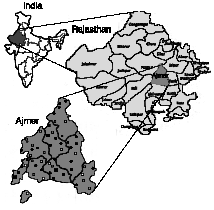
Figure 2: Ajmer District, Rajasthan, India.
Our approach was to work intensely with a few healthcare workers before
trying to build anything. From watching and listening to the ANMs and their
colleagues at the village, sector and district level, we learned about the
job of the ANM.
It took us nearly a year before we began to understand what was being asked
of us, and how we could possibly be of help by introducing Apple technology
into this setting.
THE ROLE OF THE ANM
There are about 350,000 ANMs, all women, working in India today. They are
each assigned responsibility for between 3,500 and 9,000 people whom they
visit by foot, bicycle or moped. We worked directly with 10 ANMs, mostly
from the district of Ajmer.
Not all ANMs share the same work practices, but the duties are basically
the same. Her work includes treating minor injuries and ailments, referring
people to the local hospital, providing ante and post natal care, vaccinating
people, malaria testing and motivating villagers to use contraceptives.
Each ANM receives two years training in basic healthcare and hygiene, with
refresher courses once they are working in the field.
The people she visits live in widely scattered communities which are fragmented
along caste and communal lines. Each ANM covers 3 to 5 villages or hamlets.
In the eyes of the community, the ANM is seen as a Government representative
whose purpose is primarily to enlist couples of child bearing age onto the
family welfare program. The program provides incentives and practical advice
on childbirth, ante/pre-natal care, contraception and sterilization options.
In households where people rely on having children, preferably males, to
bring in income, her advice is not always welcome. The ANMs need to possess
good communication skills and the ability to build up a level of trust with
people. This is no easy task when often the people she is working with are
a different gender, or from a community or caste not of her own.

Fig. 3: Padma with patient

Fig. 4: Padma with records
THE ACT OF RECORD KEEPING
The ANM keeps notes of her activities which she then compiles into a weekly
and monthly report. The data she collects about the villages/hamlets include
things like the number of local wells and dates on which they have been
treated with bleach, the location of ponds and times that DDT is sprayed
to keep away potential sources of malaria. She also keeps a list of weddings
and gifts.
On a household basis, she records the number of people, the name of the
head of the household and the house number. Curiously, the house numbers
and visits are often annotated on the wall near the font door by the ANM
or her helper the MPW (multi-purpose worker, usually a man). This numbering
scheme is unique to each district, and the villagers don't appear to mind
having these marks left on their houses.
For every eligible couple, the ANM records the method of contraception used,
e.g. Pill, IUD, condom etc., and the name of any Government agency worker
who may be assisting with motivating the couple to join an incentive scheme
to become sterilized.
For an individual she will record any illnesses, vaccinations, medication
given, referral, or operations performed. Records are not kept on a patient
basis, rather the action she takes is recorded on the form appropriate to
the event. For example, if a malaria slide is taken, it will be recorded
in the malaria register.
She monitors all pregnancies, births, infant mortalities and abortions.
There is paperwork for both ante and post natal care, and Mother and Child
Welfare. She records the number of disposable delivery kits dispensed, the
name of the local village birth attendant, the names of people who attend
her talks on hygiene and nutrition, the quantity of vitamins she gives out
to expectant women, and notes of difficult pregnancies and referrals to
the local hospital.
If she attends a birth, she will record the date and the approximate weight
and sex of the child. As the infant matures, a record will be kept of any
illnesses, vaccinations, and ante-natal check ups. Again, the notes will
be kept on separate forms, like the immunization card shown in Padma's hand
in Figure 3.
While on her rounds the ANM may carry a "Link Diary" where she
notes her house calls. There may be about 9 house calls in a day which covers
about 45 people, but this figure varies upon the geographic distance between
villages and hamlets. After a day of house calls, she transcribes her notes
from the link diary into the bulky register at her office called the sub
center (Figure 4).
The sub center also serves as a walk in medical post for the community.
The staff keep a basic supply of pills and vitamins, together with simple
tools for treating wounds. Although there is usually no telephone, and intermittent
electrical supply, there is usually a bed made up for patients, and a box
full of condoms outside the center for people to help themselves.
THE IMPORTANCE OF RECORD KEEPING
Something we noticed immediately was that the records she kept about her
activities had little bearing on the events which actually took place, at
least at the local level we were witnessing. Nor did there appear to be
any incentive for the ANM to complete the records accurately, since she
received no feedback for doing so, only a reprimand if the paperwork was
not handed in on time. The activity of filling in paperwork was abstract
with respect to the realities of treating camel bites and issuing contraceptives.
Yet it seemed there was no end to the number and variety of records she
kept. Was all this record keeping really any use?
"Of the approximate 1.6 million children born in Rajasthan each year,
within 12 months of their birth, 0.15 million of these children are dead
from disease, malnutrition and in the case of girls, often sheer neglect."
[5 ]

Figure 5: 40 years of records
If a Government wants to allocate appropriate funding for healthcare, it
needs to know where best to spend the money. With statistics like this for
the state of Rajasthan, it wasn't surprising that Health and Family Welfare
was a priority. However, it isn't as simple as just looking at healthcare
statistics to determine how and where to allocate resources. As Dr. Singh,
the deputy chief district medical officer in Ajmer, pointed out. "Health
is co-dependent upon the environment and education, and there are some things
you can't change over night".
It took a lot of self control on occasion, to focus on what we had been
asked to do. We centered our thoughts on what we had seen, and worked from
there.
Learning from our Observations
Many of the workers we met were dexterous with multiple form filling and
rapid reproduction of figures by hand. The system in many respects does
work. However, ANMs don't always complete the forms correctly. This can
happen for a number of reasons: they don't have time to complete the entries,
don't understand how to fill them in correctly, or the villagers have not
been entirely accurate in their descriptions. The onerous quality of the
paperwork, duplication of entries, lack of any data verification capabilities,
and overwhelming quantity of work contribute to inaccurate and missing data.
One of the reasons there are so many forms and duplication issues is because
over the last 40 years, each time there is a change in policy or a new program
or scheme implemented, a new set of forms and administrators get set up.
The old forms continue to be used, new ones arrive and often without much
explanation of how to fill them in. There was clearly an element of organized
bureaucratic wheel spinning at every level of the administration. It did
make us realize however, that re-designing a new set of paper forms was
not going to solve the problem, and neither was it our charter to suggest
changing the healthcare system.
Overview of Design Goals
From our observations of the ANMs and our discussions with the Government
we came up with a charter to try and support both the ANM and the Government
by providing a support tool to the ANM which would enable her to:
- reduce the time spent doing paper work
- increase the amount of time spent with people
- improve quality of welfare in the community
- increase the reliability of the data collected
- enable timely distribution of information to other administrators.
To meet our charter we needed to integrate the current abstract world of
paperwork with the concrete world of camel bites and condoms, and make one
reflect the other. We wrote down what it would take to make a support tool
which could help the ANM achieve these things.
- We needed to translate the paper-based record keeping to an electronic
format which would fit into the working life of the ANM.
- We needed to design a view onto the data which would mean something
to the ANM, since the format of the hand held device did not afford a 1:1
mapping of current forms to the screen size.
- We had to provide navigational structure that was natural to the
ANM's ways of entering and consulting data
- We had to provide a light weight way for entering information
Work on each point occurred at different times, by different people, with
differing levels of completion. What follows is a discussion of how we evolved
the interface elements from our observations into early paper designs to
working prototypes and informal testing in the field.
Transferring from paper to an electronic format
This was not as easy as it sounded. First we needed to collect the existing
forms, have them translated into English and plot who filled in what, where
the information was sent, and how the data gathering process influenced
the work flow of the healthcare workers up to the district level. This took
over a year to figure out, and there are still loopholes we can't explain.
Getting real data and real forms was important, because concepts for interface
designs were not well received by the very practical and dedicated members
of the healthcare community. In fact some of our expert helpers in India
were shocked that we were prepared to stand and look naive in front of healthcare
experts in the interest of learning from them what they thought of our early
paper prototypes.
Working with paper meant we could work quickly and get through a rapid number
of ideas. The first designs were primarily an exercise in explaining what
we understood of the report structure to ourselves. On index cards, we would
write the name of the various programs, e.g. immunization, and lay them
on the floor. Then we would push the cards around into different arrangements
and mimic possible scenarios the ANM might go through, when dealing with
a patient.
We then transferred these task sequences onto paper strips, which we folded.
The folds could be opened to reveal more detailed information about each
of the ANM's activities and their relationship to the various programs she
was supposed to report on paper.
During field visits we used picture cards (Figure 6) with drawings of the
typical daily activities of an ANM, taken from earlier video observations.
The cards were useful props which let us start a dialogue with the ANMs
despite the language barrier. We were able to determine the task flow of
the ANMs' work in relation to their duties, by asking them to arrange them
into the order which made most sense.
The advantage of working this way was that we were able to discuss navigation
ideas, like the folds, with the ANMs in the medium they were most used to
dealing with, before introducing it again on an unfamiliar medium like the
Newton MessagePad.

Figure 6: ANM and Picture Cards
One of the most difficult things for us to grasp about the current reporting
system was that all the records were kept on a household basis. The ANM
kept track of a group of people in household. No individual records were
kept. Households were referred to by the name of the elder male or head
of household. Quite likely his name would be the same as that of his neighbors.
In one of our early prototypes, using Hypercard, we tried a design which
showed the relationship of family members to the head of the household (Figure
7).

Fig. 7: Hypercard mockup of a household overview
In this example there are three families: Canga, Ram Karn and Ram Ratan.
The head of household is Ram Karan. The family whose record is about to
be opened is Ram Ratan and his wife Mohini. Their children, Bholu the male
and Meera the female, are listed separately according to sex.
This arrangement of people made relational sense, but was far too hard for
us as interaction designers to continue working with as a model for both
representing people and activities. Something had to give.
A leap of design faith was made. We departed from the existing system of
form filling by household to one which focused on individuals living in
the household. People would be identified by their family name and a standardized
house numbering scheme already existing.
We assumed that the software could take care of filtering field data about
an individual from their particular record into and cross referencing it
with the various programs. This approach would instantly cut down the time
spent entering data, avoid duplication, and reduce the margin of error within
the data. What we needed now was a graphical language which we could use
to make this approach make sense to an ANM's way of working.
Designing the icons
We were uncertain about introducing both new and established active graphical
elements (like scroll bars and buttons) in the interface. We didn't know
what symbolic representation would mean to an ANM. We tried to be sensitive
to the cultural conventions of the ANM and her environment, but since we
didn't know what these were, we spent a lot of time worrying about whether
we were doing the right thing. For the graphical representation, we took
our inspiration from printed literature already used by her in the field.
In many of the sub centers we found brightly colored training material the
ANM would take with her on her field visits to teach with (Figure 8). The
magazines were really compelling from both a cultural and graphical standpoint.
There were no naked bodies portrayed, and a diagram of a pregnant woman
would be depicted wearing clothes, but with the shape of the fetus drawn
over the top.

Figure 8: ANM's magazines
During a visit to the Christian Medical College in Ludhiana, Punjab we discovered
some drawings made by ANMs for illiterate birth attendants (Figure 9). This
find came after we had made our first drawings. When we saw that the icons
were of people, we started to think that we were taking an appropriate route
with our own designs.
From these observations we developed a set of icons to represent people
of different genders and ages which would correspond to the report structure
categories (Figure 10). We also developed icons for each of the programs
the ANMs administered. When we tried the icons out on the ANMs we discovered
that the icon for malaria, which we drew as a mosquito, didn't mean anything
until we explained the connection. The ANMs suggested a blood drop would
be more obvious, because it would reflect the action they take when taking
a blood sample for diagnosis.

Figure 9: Icons drawn by ANMs in Punjab.

Figure 10: Representing people by gender and age.
The set of icons was designed to be extensible. This meant that when the
ANM took an action, this action would be reflected by a subtle change in
the graphic. For example here are some changes in status of an eligible
couple. Notice that when the wife becomes pregnant a circle appears on her
belly, above her sari.

Figure 11: Modal icons reflect state of patient
Developing this extensible graphical language offered the following advantages
- it would maximize the amount of qualitative information contained
in one space
- reduce the amount of active navigation and avoid confusion
- provide immediate feedback to the ANM when changes were made by the
ANM to the person's medical record.
Providing a navigational structure
The icons were also the primary means of navigation through what is a hierarchical
database of patient records and programs.
The database is organized and represented in five levels, which lead the
ANM from the village, to household, to family, to individual levels and
then into the various programs. An Example of a typical task flow through
the interface by the ANM is shown in Figure 12.

Figure 12: ANM Task flow through MessagePad screens.
- She has heard of a new pregnancy case in the household of Ram Chand
at the village of Baghbura.
- She selects the household and is shown a view of the members she
has previously encountered on her visits: a couple with three children and
the brother Ravi with his family.
- She selects the wife's record and adds a new Ante Natal Care record.
- After the ANM has filled out the form she confirms the record.
- The wife's icons on the household level change to reflect the new
ANC case. On the village overview, the household icon will change to indicate
the presence of a patient case.
When an individual's icon is selected, an extendible list of medical events
for that person will be displayed. The list of programs is iconic. A program
can be added to the list of medical events to record the progress of, for
example a pregnancy, a disease or an immunization scheme.
Active programs have an influence on the representation of the individual's
icon. The iconic representations have been designed to give qualitative
feedback on the medical status of patients. Some of these variations to
the basic female icon are shown in Figure 13.
The small graphical changes provide the ANM with an instant overview of
patient status which she can see at the household level. This not only saves
her time looking for individual patient records, but it indicates at a glance
which individual needs attention.

Figure 13: Status of patient reflected in Icon
We did not expect the ANMs to learn the meaning of this graphical language
overnight, but we felt that even without knowing precisely what these graphical
augmentations meant, it was fairly clear that some note-worthy event had
taken place.
Entering Information
The paper-based records system currently used by the ANMs is organized by
healthcare programs. As a consequence, the ANM must enter data redundantly,
repeating information from one program's records to the others'. Additionally,
she must compile by hand data from the various programs' records once a
month into a report to her supervisor. Hence our overall design goals to
reduce time spent by the ANM in duplicate record-entry and in preparation
and transmission of reports. Electronic data entry would eliminate the need
for duplicate entries and would enable automatic report generation.
As much as possible, we tried to minimize entry of text data by hand. Pick
lists on popup menus provide a standard Newton interface element for entering
recurrent values, such as the village names, the names of diseases, etc.
Still, hand entry of text cannot be entirely eliminated. Persons' names,
new village names, and ANMs' notes for example are still entered by hand
in our prototype.
The current Newton operating system does not support Hindi handwriting recognition,
and acceptable hardware keyboards for the Newton in Hindi are not available.
An on screen software keyboard, however, offers considerable flexibility
for design. Unlike English and other languages with Roman script, Hindi
contains a relatively large number of characters, without case distinctions,
and which, in written form, often alter their appearance in accordance with
their surrounding characters. This meant we could not fit all the letters
onto one soft keyboard, but had to use two. However, the shift convention
does not apply in Hindi so we had to find a compromise. Instead, we followed
ISCII [3] key layout standards, but provided visibility to the normally
shifted (and hence invisible) set of keys via a grayed-out image (Figure
14). Tapping the Newton pen on the grayed-out image brings the second set
of keys to the front and makes them active, graying-out the first set. In
addition, the keyboard software module includes instructions for detecting
and properly rendering character combinations that need to be rendered other
than simply as typed.

Figure 14: Hindi soft keyboard
A main problem was the development of a Hindi font for this type of screen
size and resolution. A typical Asian font is about a third taller than a
Roman font (Figure 15). Most of these fonts have many rounded features and
accentuation, which are difficult to represent in a small font at a low
resolution. A special font was developed to limit the height of the characters
to be deployed in buttons, fields labels, etc.

Figure 15: Devanagari, Hespyndi 15 points
The healthcare data of the population is acquired in one of the seven different
Indian scripts. On higher levels in the Indian healthcare system this data
is transcribed into English, the official language of the national healthcare
system. Our prototype needs to support any of the main languages but we
noticed during our field studies that these even may differ greatly from
the local dialects as spoken by the ANMs. To overcome this problem we have
implemented a tool to select not only between English and the regional language
but to customize the interface elements from default choices to variations
entered with the help of local supervisors.
LEARNING BY TESTING
The project team has conducted two field studies in which approximately
10 ANMs have learned about, used, and offered feedback on our prototype
designs. Our preliminary findings include the following:

Figure 16: Padma entering data on the MessagePad
- The ANMs were not intimidated or hesitant toward using the device
(Figure 16).
- Pen input seemed to make the Newton device engaging and non-threatening,
greatly contributing to ease of use. Using the Newton stylus was intuitive
for the ANMs. The soft keyboards offered were less effective, as users had
little or no previous experience with keyboards.
- We found discrepancies between the ways ANMs enter data and what
our design actually allowed them to enter. However the navigation path into
the records hierarchy was fairly well received.
- ANMs, with their supervisors, prioritize record-keeping tasks. Our
prototype, in some respects, was more complete than necessary. Highest priorities
are on family planning, immunization of children under one year of age,
and malaria screening. Eighty-five percent of the population participate
in one or more of these three programs. The remaining fifteen percent of
the population are not relevant to the ANM's job unless they get sick.
- Localization for Hindi within the prototype was successful. In considering
this however, it is important to note that Hindi is viewed more as a spoken
than standardized written language. As a result, users may not be as 'picky'
about the representation of written text, as long as it matches their expectations
phonetically.
- We found, in many cases, that our interface text was not understood.
This often had to do with local differences and specialized ANMs' terminology.
Using Hindi equivalents for common English terms used in computer interfaces
(or using transliterations of English computer interface terms into Hindi),
such as "Cancel" or "Delete," produces confusion.
- High contrast text and icons solicited tapping, even if the area
of the display was not interactive or a desired target. ANMs relied more
on text than on recognition of icons, and, as a result, they typically tapped
on text rather than icons.
- From our observations, we realized that there is a wide variability
in the practices of our users, and this needs to be taken advantage of,
rather than just accommodated, in our design.
By careful observation, evaluation, design and testing, we have built a
working prototype of a hand held data capture device, which converts the
existing paper based reporting structure into a more useful and accurate
data capture and information retrieval model. The tedious task of data compilation
has been automated to the widest possible extent, providing an instant overview
of the latest health care provision status of the area surveyed by the ANM.
QUESTIONS AND DIRECTIONS
A central question for our research into supporting the work of the ANMs
has been whether or not a hand held computing device, such as the Newton
MessagePad, is appropriate. We cannot yet offer a definitive answer to the
question. Optimistically, the device has been well-received by the ANMs.
Feedback from the field has been encouraging regarding the acceptance of
the hardware itself, data entry methods, records navigation, and data viewing.
Essential questions remain regarding how well use of such a device can be
integrated by the ANMs into their daily routines. Our prototypes have not
yet been tested over extended use, with ANMs relying on them for their day-to-day
duties. Such testing will reveal not only integration issues, but also pragmatic
maintenance and support issues.
CONCLUSION
We hope that this methodology will enable other developers to create formats
to enable the introduction of information technologies in high volume data
capture environments for people with little or no exposure to electronic
media. By working in these settings and with these populations, we can learn
how to make technology which will empower people at large. We learned the
importance of suspending judgment and disbelief.
REFERENCES
1. Government of India. Bulletin on Rural Healthcare Statistics in India.
Government of India, New Delhi, 1995.
2. Grisedale, Sally (writer and producer), Padma's Story: A day in the life
of a Healthcare Worker in Rajasthan, India (video). Apple Computer, 1995.
3. Indian Script Code for Information Exchange p; ISCII. Bureau
of Indian Standards, New Delhi, 1991.
4. Silveira, D. M., DM Silveira's India Book 1994-95. Classic Publishers
Pvt. Ltd., Goa, India, 1995.
5. UNICEF. Rajasthan: An analysis of the Situation of Children and Women.
UNICEF, 1991.
CHI 97 Electronic Publications: Design Briefings