


|
|
© 1997 Copyright on this material is held by the authors.
However, we, as humans, rely on a wide range of subtle, but nevertheless profound, environmental cues that convey a sense of togetherness or co-presence. Sometimes it is not necessary to see a realistic image of a remote person. In such cases a more abstract representation of this person's presence in the digital environment would suffice. Perhaps a slowly moving shadow could be used to represent the form of a person or a swaying piece of hanging fabric could be an effective indication of his/her physical motions. Such abstract interfaces could be used to communicate a softer, more expressive, and poetic aspect of human experience.
In order to address these concerns, I have designed a working interactive environment that uses the familiar and intimate space of a bed. Work at the Tangible Media Group at the MIT Media Lab explores ambient environments for the presentation of background information.[3] This bed environment applies these interface design philosophies in order to help humanize inter-personal communication.
are immediately communicated to us because we are always in close physical contact. We can feel their rhythmic breathing, hear their quiet whispers, and sense their body warmth. Because of this closeness, we have an acutely hightened awareness of the physical and emotional state of one another. Therefore, this bed object is very "loaded" with meaning, as we have strong emotional associations towards such intimate and personal experiences. Work by Paul Sermon has explored the use of video projection to connect two remotely located beds to form a virtual "telepresence" between people.[4]
Curtains are often used either around a bed or next to a window. The natural behavior of curtains, due to their light fabric, visualizes patterns of airflow in the environment. Either these curtains can lightly rock from an individual's breath or be violently thrown due to a raging storm outside a window. Furthermore, curtains promote a feeling of secure enclosure within the environment, surrounding the individual with a delicate and flowing material.
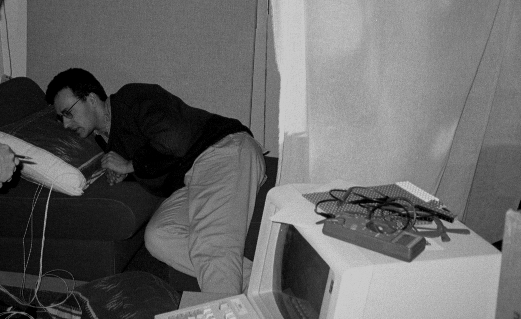
Figure 1. Photo of the bed environment prototype
Although not a physical object, shadows are a common component of the night time experience. Shadows are the vague shapes and forms that are the projections of light against physical objects, indicating the presence of unseen bodies. These uncertain forms are the source of fantasy and nightmares, as they hint at something that is not fully made clear. Out of these shadows we create stories and fables, filling in the shapes and motion with our own imagination.
Within each bed environment, there are two pillows and one curtain. Each pillow has a unique role in the environment, one is for the head and the other is a "graspable" pillow that can be pressed up against the body. Embedded in the head pillow, there are two input sensors: a non-intrusive body tracker[5] and a simple condenser microphone. In addition, there is a pair of small headphones to provide audio output. The body pillow is used as an output-only device in order to serve as a physical avatar of the remote individual. Inside the body pillow are an electric heating blanket and a large sub-woofer speaker that is capable of producing a strong physical vibration.
Hanging next to the bed is a semi-translucent curtain that forms an adequate surface for image back-projection. Along the bottom of the curtain is a row of computer controllable fans that, when turned on, force air against the curtain. This sudden air flow causes the curtain to sway in proportion with the intensity of the fan. Onto each curtain is a projection of colorful patterns. These shadows are generated by computer-controlled pumping of brightly colored liquid dyes (red, green, blue, and white) into two thinly separated Plexiglas sheets that are standing upright. These dyes mix inside the Plexiglas to form a wide range of additive colors that drip downwards. This creates an implied time dimension that is visualized through the force of gravity, causing the blending of colors over time. The entire output device is backlit by a small spotlight, casting colorful abstract shadows onto the curtain.
When both participants climb into their beds and hold their body pillows, the participants' presence is initially represented through both the warming up and the appearance of a slow, steady physical pulsing in the other's body pillow. This bridges the physical distance between the two individuals through this intermediate tangible medium: one can feel the heartbeat and the body warmth of the other. If one person begins to get restless, i.e. he/she moves about in the bed, the movement is communicated through an increase of the rate and intensity of the heartbeat in the other's body pillow.
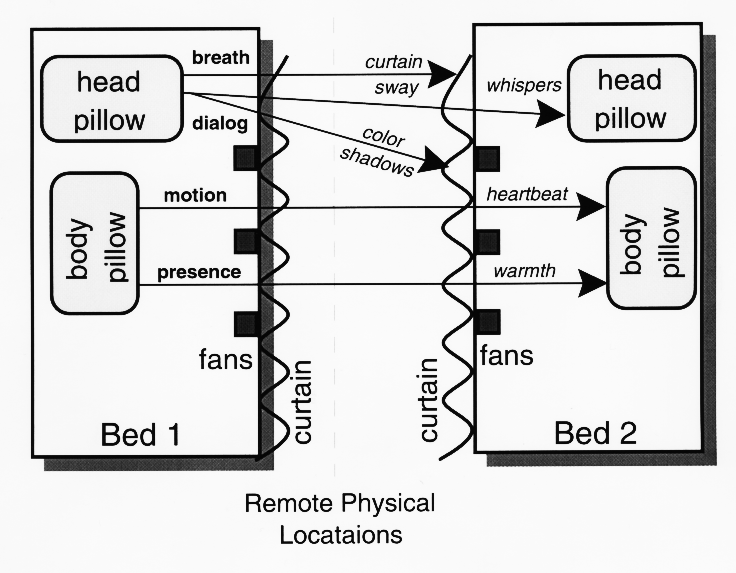
Figure 2. One set of Input/Output mappings for the symmetrical bed environment
When something is spoken, a computer analyzes the quality of the audio in terms of amplitude (softness/loudness). This quality, but not the actual audio itself, is transmitted to the remote location and is visualized through a fanciful descent of colorful shadows that are projected onto the curtains. This provides a non-literal representation of a "conversation" though an intermediate format of color. When the dialog becomes more intense, the environment uses brighter colors that tend towards the reds.
The audio analyzer also classifies between spoken conversation and "airy" noises such as breathing or blowing. If one participant blows air, this event is transmitted and reconstructed remotely through the blowing and swaying of the other's curtains, as if the breath had bridged the physical distance to change the air flow.
I would like to thank professor Hiroshi Ishii, Brygg Ulmer, and all others in the Tangible Media Group at the MIT Media Lab for their support and feedback on this project.
2. Strong, Rob and Bill Gaver. Feather, Scent and Shaker: Supporting Simple Intimacy. Proceedings of CSCW '96. pp 29-30. Nov. 1996.
3. Ishii, Hiroshi and Brygg Ullmer. Tangible Bits: Towards Seamless Interfaces between People, Bits and Atoms. Proceedings of CHI 97, ACM.
4. Sermon, Paul, Telematic Dreaming. http://208.198.184.401/history/gallery/tdreaming.html
5. Zimmerman, T., J. Smith, J. Paradiso, D. Allport, N. Gershenfeld. Applying Electric Field Sensing to Human-Computer Interfaces. Proceedings of CHI95.
|
|