


|
|
© 1997 Copyright on this material is held by the authors.
The system described in this paper was initially developed to support the Brain Opera [3], a large, touring musical installation, where a general audience can interact with musical sound and structure at a variety of interactive stations that exploit many sensing technologies to map different kinds of physical gesture into musical expression and graphics. One of the interactive environments conceived for this project involved creating a space where the position and pressure of a performer's feet would be measured together with upper-body and hand motion. This data would be used to create a truly "immersive", tetherless musical environment, where any kind of body motion would be directly and immediately converted into expressive sound.
This system has indeed been constructed, and although it does not currently tour with the Brain Opera, it has been used in several musical installations. The sensor systems used to measure the feet and upper body are described below, as is the interactive musical application created to demonstrate this environment.

The signal from each PVDF wire under the carpet is buffered by a high-impedance operational amplifier, and a pressure profile is produced by a simple diode/capacitor envelope detector. A 68HC11 microprocessor scans the resulting signals via a multiplexer (the unit that was constructed scans up to 64 wires 60 times per second), digitizing each into 8 bits. Whenever a new peak in pressure is detected, the processor sends out a MIDI (Musical Instrument Digital Interface) Note-On event, with the note number corresponding to the particular wire generating the data, accompanied by a 7-bit pressure value sent as the note velocity. Corresponding Note-Off events are sent when the pressure value from a formerly active wire decays back to the baseline. The sensor floor is very responsive; the transmitted velocity data easily distinguishes between soft foot motion and hard impacts, while careful shielding of the pickup wires and electronics virtually eliminates stray pickup and crosstalk.
The sensor heads are composed of a simple, inexpensive circuit board containing a single-transistor, 2.4 gigaHertz (GHz) CW oscillator, coupled to a 4-element micropatch antenna, which forms a broadside beam roughly 20deg. in width (although with significant sidelobes). As the radiated output is below 10 milliwatts, this system is entirely safe and well within regulation. Since nonconductive material does not significantly absorb this signal, these antennas can be easily hidden behind walls, projection displays, etc.
Doppler-shifted reflections from a performer moving within the beam return to the antenna, where they are mixed with the transmitted signal in a hot carrier diode. This produces beat frequencies in the range of 0-5 kilohertz (kHz) that directly represent the performer's dynamic state (the frequency is a function of velocity, and the beat amplitude is a combined function of the size and distance of the reflecting object). Two such diodes, placed roughly an eighth-wavelength apart, produce a quadrature pair of signals, thus their correlation determines the direction of motion along the antenna boresight. These radars respond to motion within a range of at least 15 feet.
Rather than process the Doppler signals in the Fourier domain, a simple analog signal conditioner was designed to minimize real-time computing requirements. This circuit produces three analog signals for each radar head. One of these is just the low-pass filtered amplitude envelope of the Doppler beats; this corresponds to the amount of general motion that the radar detects. Another is derived by first high-pass filtering the Doppler beats before detecting the envelope; the amplitude of this signal corresponds to the detected velocity. A third signal is derived from an analog correlation between the signals produced by the diode pair; the polarity of this voltage indicates the direction of detected motion. These 3 signals were 8-bit digitized at roughly 50 Hz, and directly used by the music-generating algorithm.
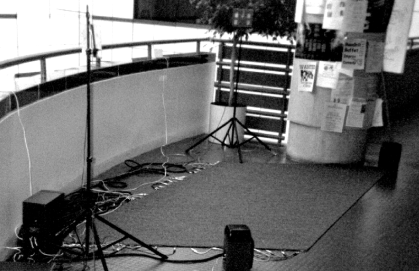
The overall, combined effect of the entire installation is a relaxing soundscape that responds to subtle movements on the part of the performer. The sound mappings allow for a good deal of expression, yet they are intuitive and simple enough for players to immediately appreciate the connection between their movements and the sound produced. The complete "Magic Carpet" system is shown in Figure 2, as installed in an elevator lobby at the MIT Media Laboratory.
2. Petruzzelis, T. The Alarm, Sensor, & Security Circuit Cookbook. McGraw-Hill/TAB, New York, 1994.
3. Paradiso, J. New Instruments and Gestural Sensors for Interactive Music Performance. Submitted to the 1997 International Computer Music Conference (ICMC).
4. Paradiso, J. The Interactive Balloon: Sensing, Actuation, and Behavior in a Common Object. IBM Systems Journal, Vol. 35, Nos. 3&4, 1996, pp. 473-487.
5. Pinkston, R., et. al. A Touch Sensitive Dance Floor MIDI Controller. Proc. of the ICMC, 1995, pp. 224-225.
|
|