CHI 97 Electronic Publications: Late-Breaking/Short Demonstrations
Learning About User-centred Design: A Multimedia Case Study Tutorial
T.T. Carey, University of Waterloo
D. Peerenboom, University of Guelph
M. Lytwyn, Bank of Montreal
Abstract
This multimedia tutorial provides a learning support system for continuing education in HCI. The system includes an authentic case study of a design project, a guide to user-cnetred design concepts, active role-playing activities and links to the larger professional community.
Keywords
HCI education, interactive multimedia, user-centred design
© 1997 Copyright on this material is held by the authors.
Introduction
User-centred Design [UCD] is a collaborative process which enables design teams to focus their attention on the users' experience for the system they are developing. LAUD is a multimedia case study tutorial for Learning About User-centred Design, being developed for the Bank of Montreal. Its target audience includes all prospective members of UCD teams, including representative users, systems designers, support staff and project managers. The system has gone through three rounds of prototypes and is scheduled for fuller usability testing in March 1997.
An introduction to user-centred design for project teams has to achieve three goals:
- persuade team members that the UCD process will be rewarding, both for cost-effectiveness and for personal satisfaction in the design process
- explain the concepts so that team members are aware of the strengths and weaknesses of UCD and of their roles and commitments
- train team members on the specific methods of UCD and provide ongoing support through checklists, template forms and personal coaching.
LAUD is targeted to the persuade and explain goals. In the Bank of Montreal, the multimedia case study tutorial is intended to be complemented with further training through ongoing coaching for the UCD process and by just-in-time learning through performance support systems for UCD team members. The multimedia elements are important in conveying the personal satisfaction of the case study team members, and in revealing the roles and reactions of the case team members so that others can understand where they fit into the process and what they will experience in their own design projects.
For a team member assigned by a project manager to work through the LAUD case study, the following learning outcomes are targeted:
- learners will understand the major steps of the UCD approach, their costs and benefits, and their impacts - including what can go wrong if the UCD process goes off course.
- learners will develop a realistic appreciation for the kind of effort required of them in a UCD project, including both roles they are likely to take on and the roles and perspectives of others on the team.
- learners will develop basic awareness of how UCD differs from other system development approaches, and that other approaches may fit better with some design challenges.
Learning scenario outline
The LAUD tutorial is introduced by Mike Hayes, the VP of Applications Development within the Electronic Banking division. In digitized video segments, Mike endorses the UCD approach and the case study they are about to encounter.
An overview of the tutorial is then presented, outlining three components:
- a case study of the UCD approach, led by a project team developing a system for Point of Sale Setup Information [POSSI]
- an exploration of the UCD concepts and methods
- a Test Drive of UCD methods, in which Val and Lee will act out roles in a UCD project.
The POSSI team introduce their story through a timeline of the major events in their project [Figure 1].
Figure 1: Case Timeline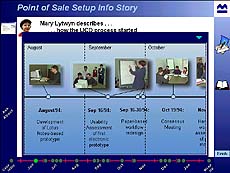
Each event is introduced with an audio overview by a team member, complemented by a visualization of the UCD activity and the people who engaged in it. Each event includes reflections on the activity and its outcomes by the team members. There are ongoing links available to commentary by the UCD concepts coach.
In the UCD Concepts Guide, the coach reviews the major UCD steps and presents a concepts map for learners to explore further. The Concepts Guide also lets learners investigate the contrasting perspectives and experiences of three roles in UCD: user representatives, system analysts and developers, and project managers.
The Test Drive component of the tutorial presents another timeline in which learners take on roles in the UCD process, using both the POSSI case study and the development of the LAUD tutorial itself as examples. In the first activity, Assembling the Team, they are asked to relive the project manager's experience in assembling the team [Figure 2].
Figure 2: Assembling the team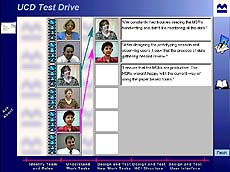
They are given a set of team members and a set of expertise which each might bring to the process - the expertise is represented by comments made about system prototypes during the POSSI project. They successfully match up almost all the team with their potential contributions, missing only the trainer's ability to anticipate user problems with the system.
Subsequent activities allow learners to engage in the POSSI case study "day in the life" experience of a system developer job shadowing a sales rep for a typical day of work with point of sale system customers, and the POSSI Work Task Design. The last two activities, User Interface Structure and User Interface Design, use the LAUD system as a case study. After each event in the Test Drive, learners encounter questions posed by their project manager which allow them to relate their own project to the UCD methods they are trying out. These "trip reports" on their journey through LAUD are returned to the project manager electronically so that they can be discussed by the whole team at the next project meeting.
LAUD Design: Instructional Strategy and Learning Activities
The overall structure for the LAUD tutorial is an adaptation of the Experiential Learning Cycle model[3], which includes successive activities to promote concrete engagement, observation and reflection, abstract conceptualization and active experimentation. The concrete engagement and observation are combined in the POSSI case study. The reflection activities are integrated into both the case study and the Test Drive, with the latter also providing the active experimentation. The UCD Concepts Guide provides the abstract conceptualization activities. Hypertext links bridge between the concepts and the case study and Test Drive components where they are used.
Within each learning activity, we have tried to follow the principles of the Cognitive Apprenticeship model [1] to encourage active, situated learning. For example, the Test Drive activities are explicitly presented as opportunities to follow through the work processes of an expert. Also, as noted below, the professional community within the Bank is presented as the owners and maintainers of the learning content.
Innovations and research issues in LAUD
The LAUD design extends previous multimedia case studies [2] by adding the Test Drive component to re-use aspects of the case. This allows learners to both observe and practice UCD methods in a realistic setting. In addition, the LAUD design includes several other innovative features to situate the learning within the larger professional community:
- the project team tells their own story, as it happened. This authenticity adds credibility to the argument being presented that the UCD process provides distinct advantages. In particular, the team's willingness to acknowledge shortcomings in their execution of the process is an important asset, both in terms of their credibility and by showing what can go wrong when the UCD process is not followed.
- the reflection activities are customized by project managers to suit the particular needs of their projects, and they receive back the comments recorded by their team members. This encourages better integration of the tutorial into the team-building process.
- the design includes Ask About..., Comment On... and Deeper Please... links to bridge from the tutorial to the larger professional community. Ask About... links will allow learners to view context-specific lists of Frequently Asked Questions, and to pose questions of their own. Comment On... links will provide simple extensions of the content by allowing additional comments, war stories and vignettes to be added. Deeper Please... links will lead to richer conceptual information and research results maintained in a university database.
LAUD is one component of a larger research context, which includes integrating several learning support systems elements and re-using the learning architecture and the interaction components for other instructional goals.
References
1. Collins, A., J.S. Brown and A. Holum (1991), Cognitive Apprenticeship: Making Thinking Visible, American Educator, Winter 1991, pp. 6-46.
2. Hsi, S. and Agogino (1994), A. M. The impact and instructional benefit of using multimedia case studies to teach engineering design. Journal of Educational Multimedia and Hypermedia, March 1994, pp.351-376.
3. Kolb, D. (1984), Experiential Learning: Experience as the source of learning and development, Englewood Cliffs NJ: Prentice Hall.
CHI 97 Electronic Publications: Late-Breaking/Short Demonstrations