

|
|
"Speech and gestures are different material carriers... they are not redundant but are related, and so the necessary tension can exist between them to propel thought forward... to make the gesture is to bring the new thought into being on a concrete plane." [7, p.18]
The temporal synchrony between speech and gesture also has been analyzed for different languages [7,8].
Currently, little parallel work is available on modality integration during human-computer interaction, although such work will be crutial to guiding the design of planned multimodal systems. Using simulated systems, empirical research has begun to reveal that contrastive functionality is an influential theme in users' multimodal integration of speech and writing. That is, people use input modes in a contrastive manner to designate a shift in linguistic content or functionality-such as digit versus text, data versus command, or original versus corrected input [14,15]. Furthermore, during map-based tasks, interacting multimodally with speech and writing has numerous performance advantages over unimodal interaction, primarily because people have difficulty articulating spatial information [10]. In addition, users' frequency of composing multimodal commands is higher in visual/spatial domains than in verbal or quantitative ones [10]. Among other things, these data suggest that spatial domains may be ideal ones for developing early multimodal systems.
The purpose of this research was to conduct a comprehensive exploratory analysis of multimodal integration and synchronization patterns during pen/voice human-computer interaction. To achieve this, a simulation experiment was conducted in which people could combine spoken and pen-based input to interact multimodally while completing varied tasks using a dynamic map system. One goal of the study was to identify when users are most likely to compose their input multimodally, rather than unimodally. A task analysis of user commands was performed to distinguish the commonality of those expressed multimodally.
A second goal of this research was to analyze the main linguistic features of multimodal constructions, as well as differences from standard unimodal ones. Basic semantic constituents were examined to determine their content, order, and the preferred mode used to convey them. The type of pen input (e.g., graphics, symbols, pointing, words) also was analyzed for different types of multimodal task command.
A third goal of this research was to investigate
how spoken and written modes are naturally integrated and synchronized
during multimodal constructions. The frequency of qualitatively
different integration patterns was examined, such as sequential,
simultaneous, and point & speak. Synchrony observed between
the spoken and written signals was assessed for temporal precedence
of one mode over the other, and for the typical lag between modes.
A "Service Transaction System" was simulated
that could assist users with map-based tasks. During a real estate
selection task, participants were asked to select an appropriate
home for a client. They were provided with a thumbnail sketch
of the client's needs, such as acceptable price range. Using a
city map, they filtered available homes until locating one meeting
their constraints. For example, during such a task, a user could
interact multimodally by circling a lakeside house icon with the
pen and asking "Is this house in a flood zone? No flood zones,
please." In response, the system would answer textually while
displaying waterways and flood zones, and it would remove the
house icon from the map if located in a hazard region. In a distance
calculation, as shown in Figure 1, the user could circle two entities
and connect a line between them while asking, "How far from
here to here?" In response, the system would provide a numeric
value in miles and a graphic confirmation of the map endpoints.
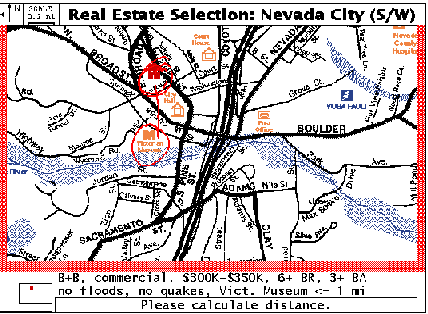
FIGURE 1. A multimodal distance calculation request, in which the user circles two locations and connects them with ink while speaking, "How far from here to here?"
During a map update task, people added, deleted, and modified information to represent changes in a high-growth municipal area. For example, a user could interact multimodally by drawing a square at a given location and saying "Make that a children's hospital." They also could draw a line along a road and say "Closed to traffic," or point to an arc across a highway and say, "Move this overpass here [drawing an arrow east] so the main hospital connects with the children's hospital." During all map tasks, users also controlled the map display by scrolling, automatically locating entities, zooming, and so forth, and they used speech and pen input for these controls too. In all cases, they interacted with an underlying map-based application as they added, removed, retrieved, or otherwise manipulated information to accomplish their task.
During the study, subjects received instructions, a general orientation to the map system's coverage, and practice using the system until its capabilities were clear. This orientation explained how to enter information on the LCD tablet when using the pen, speaking, or using a combination of both modes. During practice, users completed entire tasks using only speech or only pen, so they realized that the coverage of these alternative modes was equivalent. When writing, they were free to use cursive or printing, gestures, symbols, drawn graphics, pointing, or other marks. They were told to write information with the electronic stylus directly onto the color map displayed on their LCD tablet.
When speaking, subjects were instructed to tap and hold the stylus on the map as they spoke. A click-to-speak interface was used because off-line speech has been demonstrated to contain as many as 12,400% more unintelligible words than on-line speech directed to the system [13]. That is, massive differences can exist between the intelligibility and processability of speech in a click-to-speak versus open-microphone implementation, with click-to-speak interfaces presently offering the more viable alternative.
During the interactions reported in this study, people were free to use either or both input modes whenever they wished. They were encouraged to speak and write naturally, to work at their own pace, and to focus on completing their task. Since the goal was to uncover people's natural tendencies to interact multimodally and to integrate modes, an effort was made not to influence the manner in which they expressed themselves. People were told that the map system was well developed and tested, so it would be able to handle most of their input. If the system did not recognize their input, they always had the opportunity to re-enter their information.
People also were instructed on completing tasks using two different presentation formats: (1) a structured reference map, with the full network of roads, buildings, overlay information, and labels conventionally found on hard-copy reference maps, and (2) a less structured "minimalist" map, with one-third of the roads and overlay information as the more structured display, and only what was immediately needed to complete the task. Both map formats provided the same rapid interactivity and multimedia feedback (e.g., textual, graphic, synthetic speech) in response to user input.
After the session, a post-experimental interview
was conducted in which users were asked their preferences and
evaluation of the system. All users reported believing that the
"system" was a functional one, after which they were
debriefed about simulation details.
All interaction was videotaped and included a real-time
record of all spoken and written input and system responses. Hardcopy
multimodal transcripts also were created, with the subject's written
input captured automatically in the current map context, and verbatim
spoken input transcribed onto the printouts. Sequencing information
was annotated for the two input streams, including temporal overlap
at the word level.
For pen-based input, the basic type of semantic content was classified into the following: (1) drawn graphics (e.g., rectangle to indicate a building), (2) symbols and signs (e.g., > to indicate greater than), (3) simple pointing, (4) full and abbreviated lexical words (e.g., BR for bedroom), and (5) digits. The percentage of total pen input representing each of these categories was summarized for multimodal constructions as a function of task command, and for unimodal written ones.
The type and frequency of spoken spatial deictics (e.g., "there") was summarized, as was the percentage of multimodal constructions containing a deictic term.
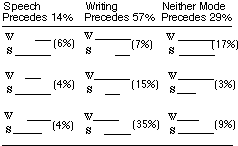
For the sequential and compound integration patterns, microanalyses were conducted from videotapes of which mode preceded the other, and of the average time lag between the end of the first input mode and the onset of the second one. Simultaneous constructions were classified into nine logically possible overlap patterns, displayed in Table 4. These classifications were designed to code the relative temporal order of signal onset and offset for spoken and written input, and to provide temporal distinctions about coordination between signals accurate to within 0.1 sec. Simple point & speak input was not included in this analysis of simultaneity, since it was considered to involve completely overlapped signals by necessity of the click-to-speak interface.
In addition to analyses at the utterance level, the
integration of spoken and written input was analyzed for multimodal
constructions with a spoken deictic. In these cases, the temporal
relation between the spoken deictic term and the specific pen-based
mark that disambiguated the deictic's meaning were microanalyzed
to determine whether they occurred simultaneously or sequentially,
and to assess typical precedence relations and time lags. These
analyses were based on temporal information about the onset and
offset of the spoken deictic term, as well as spatial/temporal
information about the beginning and end of the formation of the
relevant written mark, which were analyzed from videotapes.
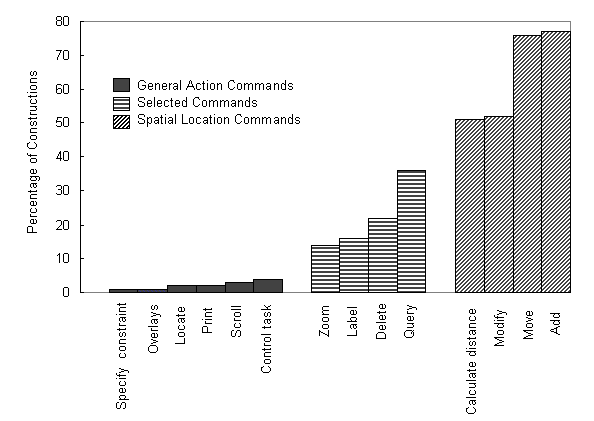
FIGURE 2. Percentage of all constructions that users expressed multimodally as a function of task command, with spatial location commands on the right, selection commands in the middle, and general action commands on the left.
Of 871 individual constructions, users expressed 167 multimodally by combining speech and writing within the same sentence, or 19%. Unimodal writing accounted for 17.5% of all sentences, and the remaining 63.5% of sentences were uttered just using speech.
Commands that involved selecting a specific object from others displayed on the map had an intermediate likelihood of being expressed multimodally. These selection commands accounted for 11% of users' multimodal constructions, ranging between 14 and 36% (Figure 2, middle). Such commands identified an object of interest and its location, but no complex spatial information. They included querying for information about an object, and deleting, labeling, or zooming on an object. Commands that involved selecting an in-view object were more likely to be expressed unimodally than multimodally, because the object sometimes was already in focus from: (1) previous dialogue context (e.g., user adds new map object, then deletes it), or (2) visual context (e.g., user zooms on a house photo, then queries for information about it). Sometimes the object simply was one of a kind or easy to describe. In none of these cases did the user have a compelling need to physically gesture to an object to select it.
The remaining six types of task command were rarely expressed multimodally, accounting for only 3% of all constructions (Figure 2, far left). This third subgroup involved general action commands, which required neither a spatial description nor identification of an in-view object. They included controlling task procedures, scrolling the display, printing, automatically locating out-of-view objects, calling up map overlays, and specifying constraints for filtering information.
A Wilcoxon Signed Ranks analysis confirmed that spatial location commands were significantly more likely to be expressed multimodally than selection commands, T+ = 115 (df = 15), p < .0003, one-tailed. In addition, selection commands were significantly more often multimodal than general action commands, T+ = 28 (df = 7), p < .008, one-tailed.
Unimodal speech:
"Add a boat dock on the west end of Reward Lake."
"I want to see the photo of the house on the southwest end of Reward Lake, please."
Multimodal:
[draws line] "Add dock here."
TABLE 1. Percentage of multimodal and speech-only constructions for which the locative constituent [LOC] occurred in sentence initial vs. final position, rather than mid-sentence.
Table 2 illustrates that different classes of written input predominated during different types of multimodal task command. Graphic input was the most prevalent during spatial location commands, occurring primarily when an object was added to the map. In contrast, pointing predominated during selection commands, and written words during general action commands. Written symbols and signs were used in a relatively stable manner, irrespective of command type. For comparison, the far right column of Table 2 illustrates that words were predominant during unimodal written sentences, with 52% of these general action commands.
TABLE 2. Categories of pen-based input during multimodal constructions (listed by task command), and unimodal written constructions.
TABLE 3. Percentage of multimodal constructions represented by different types of speech/writing integration pattern.
| Point & Speak | ||||
| Draw & Speak | ||||
| ---Simultaneous Draw & Speak | ||||
| ---Sequential Draw & Speak | ||||
| ---Compound Draw & Speak | ||||
TABLE 4. All logically-possible temporal overlap patterns between speech and written input for simultaneous integrations, subclassified by temporal precedence of input mode.
Two subjects produced utterances in which speech was abnormally elongated as a result of attempting to perfectly synchronize the beginning and end of speech and drawing. For example, while marking a closed section of road one subject said, "No automobiles" (underlined syllables elongated). However, only 2% of multimodal utterances were affected by such distortion.
Figure 3 illustrates the distribution of lags for sequential constructions. The lag between the end of the pen signal and start of speech averaged 1.4 secs, with 70% of all lags ranging between 0.0 and 2.0 sec, 88% between 0.0 and 3.0 sec, and 100% between 0.0 and 4.0 sec.

FIGURE 3. Distribution of lag times between end of pen signal and onset of speech in sequential multimodal constructions.
One implication of these findings is that knowledge of the task commands anticipated in an application could influence the fundamental design choice to build a multimodal versus unimodal interface. In a multimodal system, knowledge of a given command (generally indicated by the spoken verb) also could be used to weight likelihoods that the incoming signal is: (1) unimodal, or (2) part of a multimodal construction in which speech input is expected to follow pen within a given lag. In the latter case, knowledge about the type of command could influence architectural decisions about when to begin processing, and the signal's interpretation.
Among the powerful interface features of pen-based input are its ability to convey precise location information and detailed graphic renderings. Another is the multi-functional capability of pen systems, which can support qualitatively different types of input such as drawings, symbols and signs, gestures, words, digits, and pointing. The present data indicate that knowledge of the command type also provides predictive information about the kind of pen input most likely to be elicited from users, which will need to be processed by the recognizer. For example, spatial location commands (e.g., add) primarily elicited drawn graphics, whereas selection commands elicited pointing and gestures (e.g., circling an object), and general action commands elicited words. In designing future multimodal applications, information about expected task commands therefore ought to be considered before specifying a planned system's basic recognition capabilities.
The past literature on multimodal systems has focused largely on simple selection of objects or locations in a display, rather than considering the broader range of multimodal integration patterns. In this corpus, speech combined with pointing for selection was not the dominant integration theme, accounting for only 17% of multimodal constructions. Most pen input was not written words either (accounting for 7%), perhaps contrary to expectations of the handwriting recognition community. Instead, drawn graphics (e.g., square for building) and symbols/signs (e.g., arrow to indicate movement) accounted for most, or 76%, of all written input. Given the more powerful and multifunctional capabilities of new pen devices, which can generate symbolic information as well as selecting things, it is clear that a broader set of multimodal integration issues needs to be addressed in future work.
Previous specialized processing approaches based on the interpretation of spoken deictics via synchronous pointing (i.e., by "calling out" for a matching x,y coordinate on a display to resolve an intended referent in a phrase like "that blue square" [1,4]) are unlikely to play a large role in handling the types of construction actually observed in the present corpus. First, most multimodal constructions, or 59%, did not contain any spoken deictic, so one cannot count on their presence to flag and assist in interpreting the referent in a visual display. Second, even fewer multimodal constructions, or 25%, contained a spoken deictic that overlapped in time with the pen input needed to disambiguate its meaning. Third, as noted above, only 17% of multimodal constructions involved a simple point-and-speak pattern. Finally, as the present data attest, users actually may only compose individual sentences multimodally a limited percentage of the time. To process what may be as many as 80% of linguistic constructions unimodally in a multimodal-capable interface, a system designed for a real application must be able to interpret standard unimodal referring expressions and resolve reference through both dialogue and visual context as in previous multimodal designs [2,9]. In this context, specialized algorithms for processing deictic-point relations have limited practical utility.
One important distinguishing characteristic of spoken and pen input is that both modes can convey symbolic content such as language. Analysis of the linguistic content of integrated speech/writing constructions in this study revealed several interesting things. First, at a semantic level, the spoken and written modes consistently contributed different and complementary information. Basic constituents describing the subject, verb, and object almost always were spoken, whereas constituents describing locative information invariably were written. Furthermore, consistent with McNeill's [7] observations, it was extremely rare for such information to be duplicated in both modes. These data confirm the importance of contrastive functionality as a major theme that drives the overall patterning of people's integrated use of input modes [14]-with locative/nonlocative content the salient contrast in this visual/spatial domain. Second, multimodal constructions were briefer and syntactically simpler than unimodal spoken ones, and therefore potentially easier for a system to process (see [12] for further discussion). Third, the order of incoming linguistic information in multimodal constructions clearly departed from the canonical S-V-O-LOC order typical of spoken English. Instead, pen-based locative information was presented first and followed by spoken constituents, resulting in a LOC-S-V-O sequence.
With respect to synchronization of input streams, a major theme for both sequential and simultaneous patterns was the strong temporal precedence of written input, which prevailed independent of the click-to-speak or open-microphone implementation. During sequentially integrated draw-and-speak constructions, a drawn graphic was completed before the onset of any spoken input 99% of the time. Analysis of the lags revealed that speech followed writing within an average of 1.4 seconds, and always began within 4 seconds of pen input. When drawing and speech overlapped in simultaneous constructions, the onset of pen input still preceded speech more often than the reverse (57% vs. 14% of cases). Finally, analysis of spoken deictics and their disambiguating marks revealed that pen input preceded the deictic term 100% of the time when these signals were sequential, and 60% of the time when simultaneous. This observed precedence of pen input generalized over both system and simulation testing, involving click-to-speak and open-microphone interfaces. Future simulation research should explore typical integration patterns between other promising modality combinations, such as speech and 3-D gestures or speech and gaze, for interacting with other types of visual display- as well as their relation to the spoken and pen-based integration patterns reported here.
One interpretation of the temporal precedence of writing to convey locative content is that users were elaborating the visual context of the map with their ink marks and, after this expanded context was available, they then continued by speaking about it. The act of drawing and permanence of the written marks may have had an important self-organizing influence on users thinking and subsequent speech. During interpersonal communication, both signed language and natural gestures also have been reported to precede or occur simultaneously with their spoken lexical analogues [3,5,8]. Some variation has been found in integration patterns between languages, such that topic-prominent languages like Chinese present gestures further in advance of the speech stream (i.e., as a kind of "framing constraint" for the sentence) than do subject-prominent languages like Spanish or English [7]. Although gesturing is ephemeral and seemingly unlike the permanence of ink, people sometimes engage in a "poststroke hold" that can perpetuate the gesture as a visual context for speech in the same way that ink does. In this sense, the dynamics of context-setting can function similarly in eliciting advance writing and manual gesturing.
From a more pragmatic perspective, the order of input modes and average lag times reported in this paper could be used to weight probabilities associated with the likelihood that a sentence is multimodal versus unimodal, the likelihoods associated with different utterance segmentations (e.g., that an input stream containing [speech, writing, speech] should be segmented into [S / W S] rather than [S W / S]), and to correctly recognize content within the spoken and written input streams. Current systems that time-stamp and jointly process two or more input modes have not reported temporal thresholds for performing integrations between modes. Data on typical inter-modal lags collected during realistic interactive tasks, such as those reported here, could form the basis of highly accurate mode integrations in future multimodal systems.
The present empirical research has inspired the design and architectural implementation of multimodal systems in our laboratory, which support map-based applications ranging from real-estate and health-care selection to military simulation [16]. In these systems, the user communicates through a hand-held PC that processes speech and pen input in parallel, using a joint interpretation strategy involving a statistically-ranked unification of semantic interpretations. Compared with unimodal recognition, such systems have the advantage of supporting mutual disambiguation of linguistic content and reduction of error. Given the complex and nonintuitive nature of users' multimodal interaction during real tasks, empirical work will be essential in guiding the design of future robust multimodal systems.
** Collaborators' affiliations: Psychology Dept., University of Trieste, and Linguistics Dept., Portland State University.
1 Empirical analysis confirmed that intentional pointing to a particular referent was distinct from untargeted tapping on the tablet simply to engage the click-to-speak interface (i.e., for which the pen could drop to the nearest tablet location), with the former averaging 1.7 sec, versus 1.4 sec for the latter.
2 Spoken deictic terms such as "here" and "this" point out locations in the spatial context shared by communication participants, and often are accompanied by gesturing.
3 Gesture formation can be classified into a preparatory phase, main stroke, poststroke hold, and retraction.
2. Cohen, P., Dalrymple, M., Moran, D. & Pereira, F. Synergistic use of direct manipulation and natural language, CHI '89 Conf. Proc., ACM: Addison Wesley, New York, 1989, 227-234.
3. Kendon, A. Gesticulation and speech: Two aspects of the process of utterance, The Relationship of Verbal and Nonverbal Communication (ed. by M. Key), The Hague: Mouton, 1980, 207-227.
4. Koons, D., Sparrell, C. & Thorisson, K. Integrating simultaneous input from speech, gaze, and hand gestures, Intelligent Multimedia Interfaces, ed. by M. Maybury, MIT Press: Cambridge, MA, 1993, 257-76.
5. Levelt, W., Richardson, G. & Heu, W. Pointing and voicing in deictic expressions, Jour. of Memory and Language, 1985, 24, 133-164.
6. McNeill, D. Hand and Mind: What gestures reveal about thought, Univ. of Chicago Press: Chicago, Ill., 1992.
7. McNeill, D. Language as gesture (Gesture as language), Proc. of the Workshop on the Integration of Gesture in Language & Speech, ed. by L. Messing, Univ. of Delaware, Oct. 1996, 1-20.
8. Naughton, K. Spontaneous gesture and sign: A study of ASL signs co-occurring with speech, Proc. of the Workshop on the Integration of Gesture in Language & Speech, ed. by L. Messing, Univ. of Delaware, Oct. 1996, 125-34.
9. Neal, J. & Shapiro, S. Intelligent multi-media interface technology, in Intelligent User Interfaces (J. Sullivan & S. Tyler, eds.), ACM: Addison Wesley, New York, 1991, ch. 3, 45-68.
10. Oviatt, S.L. Multimodal interfaces for dynamic interactive maps, CHI '96 Conf. Proc., New York, ACM Press, 1996, 95-102.
11. Oviatt, S., Cohen, P., Fong, M., & Frank, M. A rapid semi-automatic simulation technique for investigating interactive speech and handwriting, Proc. of the Intl. Conf. on Spoken Language Processing, 1992, 2, 1351-54.
12. Oviatt, S., Cohen, P. Johnston, M. & Kuhn, K. Multimodal language: Linguistic features and processing requirements, forthcoming.
13. Oviatt, S., Cohen, P. & Wang, M. Toward interface design for human language technology: Modality and structure as determinants of linguistic complexity, Speech Communication, 1994,15 (3-4), 283-300.
14. Oviatt, S. & Olsen, E. Integration themes in multimodal human-computer interaction, Proc. of the Intl Conf. on Spoken Language Processing, 1994, 2, 551-554.
15. Oviatt, S. L. & vanGent, R. Error resolution during multimodal human-computer interaction, Proc. of the Intl. Conf. on Spoken Language Processing, 1996.
16. Pittman, J., Cohen, P., Smith, I., Yang, T. &
Oviatt, S. Quickset: A multimodal interface for distributed interactive
simulations, Proc. of the 6th Conf. on Computer-Generated Forces
& Behavior Representation, Univ. of Central Florida, Orlando,
FL., 1996, 217-24.
|
|