

|
|
Furthermore, when physical constraints guide the tool placement, this fundamentally changes the type of motor control required. The task is tremendously simplified for both hands, and reversing roles of the hands is no longer an important factor. Thus, specialization of the roles of the hands is significant only for skilled manipulation.
The present experiment was motivated by our experiences with the props-based interface for neurosurgical visualization [14]. This is a 3D user interface based on the two-handed physical manipulation of hand-held tools, or "props", and was designed to allow neurosurgeons to visualize volumetric medical image data. From the neurosurgeons's perspective, the interface is analogous to holding a miniature head (a doll's head) in one hand which can be "sliced open" or "pointed to" using a cross-sectioning plane or a stylus tool, respectively, held in the other hand (fig. 2).
Informally, we observed that the operation of the interface was greatly simplified when both hands were involved in the task. But in the early design stages, we were faced with many possible ways that the two hands might cooperate. An early prototype allowed users to use both hands, but was still difficult to use. The nonpreferred hand oriented the doll's head, and the preferred hand oriented the cross-sectioning plane, yet the software did not pay any attention to the relative placement between the left and the right hands. Users felt like they were trying to perform two separate tasks which were not necessarily related.
Figure 1: A subject performing the experimental task.
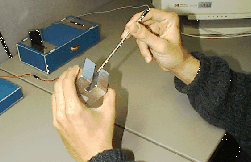
Figure 2: The props interface for neurosurgical visualization [14].

For truly bimanual movement, most experiments have studied tasks which require concurrent but relatively independent movement of the hands. Example tasks include bimanual tapping of rhythms [7][26][35] and bimanual pointing to separate targets [20][23][34]. Since the hands are not necessarily working together to achieve a common goal, we cannot be sure that these experiments apply to cooperative bimanual action.1
There are a few notable exceptions, however. Buxton and Myers [5] demonstrated that computer users naturally use two hands to perform compound tasks (positioning and scaling, navigation and selection) and that task performance is best when both hands are used. Buxton has also prepared a summary of issues in two-handed input [6].
Kabbash [19] studied a compound drawing and selection task, and concluded that two-handed input techniques, such as ToolGlass [3], which mimic everyday "asymmetric dependent" tasks yield superior overall performance. In an asymmetric dependent task, the action of the right hand depends on that of the left hand [19][9]. This experiment did not, however, include any conditions where the action of the left hand depended on the right hand.
Guiard performed tapping experiments (Fitts' task) with a bimanually held rod [11]. Subjects performed the tapping task using two grips: a preferred grip (with one hand held at the end of the rod and the other hand near the middle) and a reversed grip (with the hands swapping positions). The preferred grip yielded better overall accuracy, but had reliably faster movement times only for the tapping condition with the largest amplitude. Guiard also observed a distinct partition of labor between the hands, with the right hand controlling the push-pull of the rod, and the left hand controlling the axis of rotation.
A number of user interfaces have provided compelling demonstrations of two handed input, but most have not attempted formal experiments. Three-dimensional virtual manipulation is a particularly promising application area. Examples include MultiGen Smart Scene [24], the Virtual Workbench [27], 3Draw [29], Worlds-in-Miniature [31], and work by Shaw [31] and Abel [1]. There is also some interest for teleoperation applications [32]. In two dimensions, examples include Toolglass [3], Fitzmaurice's Graspable User Interface [8], and Leganchuk's bimanual area sweeping technique [21].
Bolt [4] has investigated uses of two hands plus voice input. Hauptmann [13] showed that people naturally use speech and two-handed gestures to express spatial manipulations.
The KC model hypothesizes that the left and right hands make up a functional kinematic chain: for right-handers, the (distal) right hand moves relative to the output of the (proximal) left hand. This leads to three general principles:
Looking beyond the hands, one might also apply the KC model to reason about multiple effector systems ranging from the hands and voice (playing a piano and singing [10]), the hands and feet (operating a car's clutch and stick shift), or the multiple fingers of the hand (grasping a pen).

Figure 3: Experiment configuration. The monitor seen at the right of the working area displays the stimuli for each trial.
For the Hard task, the subject must mate the tool and the target object so that the tool touches only the target area (fig. 4). The target area is wired to a circuit that produces a pleasant beep when touched with the tool; if the tool misses the target area, it triggers an annoying buzzer which signals an error. The target area is only slightly larger than the tool, so the task requires dexterity to perform successfully. The subject was instructed that avoiding errors was more important than completing the task quickly.
For the Easy task, the subject only has to move the tool so that it touches the bottom of the rectangular slot on the target object. The buzzer was turned off and no "errors" were possible: the subject was allowed to use the edges of the slot to guide the placement. In this case, the subject was instructed to optimize strictly for speed.
Each subject performed the Hard and the Easy task using two different grips, a Preferred grip (with the left hand holding the target object and the right hand holding the tool) and a Reversed grip (with the implements reversed). This resulted in four conditions: Preferred Hard (PH), Preferred Easy (PE), Reversed Hard (RH), and Reversed Easy (RE).
Subjects were required to hold both objects in the air during manipulation (fig. 1), since this is typically what is required when manipulating virtual objects. Subjects were allowed to rest their forearms or wrists on the table, which most did. Subjects sat in a rolling office chair with armrests.
For the Hard task, the dependent variables were time and errors (a pass / fail variable). For the Easy task, since no errors were possible, only time was measured. Time was measured from when the tool was removed from the platform (fig. 3) until the tool touched the target area; this measure did not include the time to initially grasp the tool or to return the tool to the platform when done with the task.
The specific hypotheses for this experiment are as follows:
H1: The Hard task is asymmetric and the hands are not interchangable. That is, the Grip (preferred, reversed) used will be a significant factor for this task.
H2: For the Easy task, the opposite is true. Reversing roles of the hands will not have a reliable effect.
H3: The importance of specialization of the roles of the hands increases as the task becomes more difficult. That is, there will be an interaction between Grip (preferred, reversed) and Task (easy, hard).
H4: Haptics will fundamentally change the type of motor control required.
The experiment began with a brief demonstration of the neurosurgical
props interface (fig. 2) to
engage subjects in the experiment. We suggested to each subject that
he or she should "imagine yourself in the place of the surgeon" and
stressed that, as in brain surgery, accurate and precise placement was
more important that speed. This made the experiment more fun for the
subjects, who would sometimes joke that they had "killed the patient"
when they made an error.
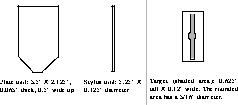
Figure 4: Dimensions of the Plate and Stylus tools (left); Dimensions of the target (right). For the Hard task, hitting anywhere outside the shaded area triggered an error.
Figure 5: Target Objects. A target (fig. 4, right) was centered at the bottom of each slot. Each slot is 0.75" deep by 0.375" wide.

For the experimental trials, a within-subjects latin square design was used to control for order of presentation effects. For each of the four experimental conditions, subjects performed 24 placement tasks, divided into two sets of 12 trials each. Each set included two instances of all six possible tool and target combinations, presented in random order. There was a short break between conditions.
Two platforms were used, one to hold the tools and one to hold the target objects (fig. 3). The tool platform was instrumented with electrical contact sensors, allowing us to detect when the tool was removed from or returned to the platform. Returning the tool to the platform (after touching the target) ended the current trial and displayed a status report. The subject initiated the next trial by clicking a footpedal.
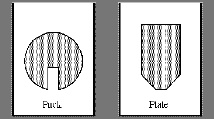
Figure 6: Sample screen showing experimental stimuli.
Each subject was seated so that the midline of his or her body was centered between the two platforms. The tool platform was flipped 180° during the Reversed conditions, so that the plate was always the closest tool to the objects. The platforms were positioned one foot back from the front edge of the desk, and were spaced 6" apart.
Figure 5 shows the dimensions for the cube, triangle, and puck target objects. Each object was fitted with an identical target (fig 4, right) which was centered at the bottom of the rectangular slot on each object. The objects were machined from delrin and wrapped with foil so they would conduct. The target area and the foil were wired to separate circuits; some capacitance was added to each circuit to ensure that even slight contacts would be detected.
When using the plate, subjects were instructed to use the entire 0.5" wide tip of the plate to touch the target. For the stylus, the subject was told to touch the rounded part of the target area (the stylus was thicker than the other parts of the target).
Second, our accuracy measurement yields a dichotomous pass / fail outcome. Thus, we have no quantitative information about the magnitude of the errors made when the subjects missed the target in the Hard conditions.
A straightforward analysis of the Hard task shows a strong lateral asymmetry effect. For both the plate and the stylus tools, 15/16 subjects performed the task faster in the PH condition than in the RH condition (significant by the sign test, p < .001). The difference in times is not due to a time / accuracy trade-off, as 15/16 subjects (using the plate) and 14/16 subjects (using the stylus) made fewer or the same amount of errors in the PH condition vs. the RH condition.
For the Easy task, as predicted by Hypothesis 2, the lateral asymmetry effect was less decisive. For both the plate and the stylus tools, 11/16 subjects performed the task faster in the PE condition than in the RE condition (not a significant difference by the sign test, p > .20). For at least one of the tools, 6/16 subjects performed the task faster in the RE condition vs. the PE condition.
Table 1 summarizes the mean completion times and error rates. No errors were possible in the Easy conditions. In the Hard conditions, the relatively high error rates resulted from the difficulty of the task, rather than a lack of effort. We instructed the subjects that "avoiding errors is more important than speed," a point which we emphasized several times and underscored by the analogy to performing brain surgery.
Table 1: Summary of mean completion times and error rates.
Condition |
Mean |
Std. dev. |
Error rate |
|---|---|---|---|
|
Preferred Easy (PE)
|
0.76
|
0.15
|
--
|
|
Reversed Easy (RE)
|
0.83
|
0.19
|
--
|
|
Preferred Hard (PH)
|
2.33
|
0.77
|
43.9%
|
|
Reversed Hard (RH)
|
3.09
|
1.10
|
61.1%
|
We observed three patterns of strategies in our subjects when they were performing the Hard task:
At first glance, it would seem that the primary difference between the RH and the PH conditions was the left hand's unsteadiness when handling the tools. For at least some of the subjects, however, it also seemed that the right hand had difficulty setting the proper orientation for the action of the left hand. So the right hand was best at fine manipulation, whereas the left hand was best at orientating the target object for the action of the other hand.
For the Easy tasks, we did not notice any specific strategies. Subjects were divided about whether or not the RE task was unnatural. Some thought it was "definitely awkward," others thought it was "fine." At least one subject preferred the Reversed grip; this preference was confirmed by a small Reversed grip advantage in the quantitative data.
Finally, when switching to the Hard task after performing a block of the Easy task, subjects often took several trials to adjust to the new task requirements. Once subjects became used to relying on physical constraints, it required a conscious effort to go back. To assist this transition, we instructed subjects to "again emphasize accuracy" and to "focus initially on slowing down."
Table 2: Significance levels for Main effects and Interaction effects.
Overall, the preferred Grip was significantly faster than the reversed Grip and the easy Task was significantly faster than the hard Task. The Tool and Object factors were also significant, though the effects were small. The plate Tool was more difficult to position than the stylus: this reflects the requirement that the subject must align an additional degree of freedom with the plate (rotation about the axis of the tool) in order to hit the target. The cube Object was somewhat more difficult than the other Objects.
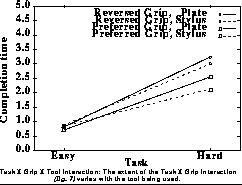
Figure 7: Task X Grip interaction: The difference between the Preferred and the Reversed grips increases as the task becomes more difficult.
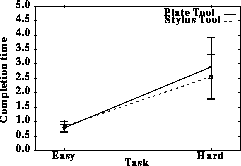
Figure 8: Tool X Task interaction: the plate is slightly faster for the easy task, but is slower for the hard task.
Figure 9: Task X Grip X Tool interaction: The extent of the Task X Grip interaction (fig. 7) varies with the tool being used.
Table 2 reports pooled effects across the easy and hard Task and the preferred and reversed Grip. Based on our hypotheses, we also compared the individual experimental conditions. These are summarized in Table 3.
| Contrast | F statistic | Significance |
|---|---|---|
|
PE vs. RE
|
F(1,15) = 3.94
|
Not significant
|
|
PH vs. RH
|
F(1,15) = 33.56
|
p < 0.0001
|
The Grip factor is significant for the Hard task (PH vs. RH), but not the Easy task (PE vs. RE). This supports Hypothesis 1: the task is asymmetric and reversing the roles of the hands has a significant effect. The Grip factor was not significant for the Easy task. This evidence supports Hypothesis 2; reversing the roles of the hands has a significant impact on performance only for the hard task, and not for that easy task. Note however that this experiment does not prove that there is no effect of Grip on the easy task; it only proves that any such effect is relatively small.
There was a small, but significant, main effect of Gender, along with several significant interactions (table 4). Although this experiment was not designed to detect gender differences, this finding is consistent with the literature, which suggests that females may be better at some dexterity tasks [12].
Table 4: Overall Gender difference effects.
| Factor | F statistic | Significance |
|---|---|---|
|
Gender
|
F(1,14) = 5.55
|
p < .05
|
|
Tool X Gender
|
F(1,14) = 12.80
|
p < .005
|
|
Task X Gender
|
F(1,14) = 5.23
|
p < .05
|
|
Tool X Task X Gender
|
F(1,14) = 20.90
|
p < .0005
|
To ensure that Gender is not a distorting factor, we performed separate ANOVA's with N=8 male and N=8 female subjects. This is a less sensitive analysis, but the previous pattern of results still held: Grip, Task, and the Grip X Task interaction were all significant for both groups (table 5).
H1: The Hard task is asymmetric and the hands are not interchangable. This hypothesis was supported by the overall Grip effect and the Preferred Hard vs. Reversed Hard contrast, both of which were highly significant. The suggestion we see in this result is that maniplation is most natural when the right hand works relative to the left hand.
There are several qualities of the experimental task which we believe led to the lateral asymmetry effects:
H2: For the Easy task reversing roles of the hands will not have any reliable effect. The Grip effect was much smaller for the Easy task, but was significant at the p < 0.10 level, so we cannot confidently conclude there was no Grip effect. Nonetheless, for practical purposes, lateral asymmetry effects are much less important here.
In the Easy task of the experiment, movement was almost a complete switch to a bimanual symmetric style of motion. Exactly when do manipulative movements require asymmetric rather than symmetric bimanual action? Is there a smooth transition from easy to hard, symmetric to asymmetric manipulation, or is there a sudden crossover?
This work has focused on the motoric aspects of bimanual action, but we strongly believe that two-handed manipulation can have cognitive implications as well. For example, Leganchuk [21] has suggests that a bimanual technique for sweeping out rectangles can reduce cognitive load.
In other work, we have explored how the two hands together can help users to form a better sense of the virtual space in which they are working [16]. With two hands, users maintain a precise, body-relative representation of space which is not dependent on visual feedback. The experimental data suggest that two hands are not just faster than one hand. Using both hands can provide the user with information which one hand alone cannot; using both hands can furthermore change how users think about a task by influencing the user's problem-solving strategy. When designed appropriately, two-handed interfaces can improve the bandwidth between the human and the computer, thereby helping users to perform significant intellectual tasks [17].
2. Annett, J., Annett, M., Hudson, P., Turner, A., "The Control of Movement in the Preferred and Non-Preferred Hands," Q. J. Exp. Psych., 31, 641-652.
3. Bier, E., Stone, M., Pier, K., Buxton, W., DeRose, T., "Toolglass and Magic Lenses: The See-Through Interface," SIGGRAPH `93, pp. 73-80.
4. Bolt, R. A., Herranz, E., "Two-Handed Gesture in Multi-Modal Natural Dialog," UIST '92, pp. 7-13.
5. Buxton, W., Myers, B., "A Study in Two-Handed Input," Proc. CHI'86, pp. 321-326.
6. Buxton, W., "Touch, Gesture, and Marking," in Readings in Human-Computer Interaction: Toward the Year 2000, Morgan Kaufmann Publishers, 1995.
7. Cremer, M., Ashton, R., "Motor performance and concurrent cognitive tasks", J. Motor Behavior, 13, pp. 187-196, 1981
8. Fitzmaurice, G., Ishii, H., Buxton, W., "Bricks: Laying the Foundations for Graspable User Interfaces," Proc. CHI'95, pp. 442-449.
9. Guiard, Y., "Asymmetric Division of Labor in Human Skilled Bimanual Action: The Kinematic Chain as a Model," J. Motor Behavior, 19 (4), 1987, pp. 486-517.
25. Oldfield, R., "The assessment and analysis of handedness: The Edinburgh inventory," Neuropsych-ologia, 9, pp. 97-113, 1971.
31. Shaw, C., Green, M., "Two-Handed Polygonal Surface Design," Proc. UIST'94, pp. 205-212.
34. Wing, A., "Timing and co-ordination of repetitive bimanual movements," Quarterly. J. Exp. Psych., 34A, pp. 339-348, 1982.
2 The mean laterality quotient obtained in the Inventory was 71.7.
3 This also doubled as a lateral preferences assessment, to ensure that each subject actually did prefer the "Preferred" grip to the "Reversed" grip.
|
|