

|
|
(1) Centre d'Études de la
Navigation Aérienne
7 avenue Edouard Belin
31055 Toulouse cedex
France
(2) Input Research Group
CSRI
University of Toronto
Toronto, ON M5S 1A4
Canada
(3) IBM Almaden
Research Center
650 Harry Road
San Jose, CA 95120
USA
 ,
that is:
,
that is:

where a and b are empirically determined constants, and c is 0, 0.5 or 1
(See [14] for detail). The factor  , called the index of difficulty (ID), describes the
difficulty to achieve the task: the greater ID, the more difficult the task.
, called the index of difficulty (ID), describes the
difficulty to achieve the task: the greater ID, the more difficult the task.
Due to its accuracy and robustness, Fitts' law has been a popular research topic. Numerous studies have been conducted to explain [6, 9], extend [13] and apply Fitts' law to various domains. The value of Fitts' law in human-computer interaction research can be readily appreciated. Taking input device research as an example, it was nearly impossible to compare device performance results from different studies until the Fitts' law model was applied [3]. Without Fitts' law, performance scores (pointing/tapping times) are only meaningful under a set of specific experimental conditions (target sizes and distances). With Fitts, these scores can be translated into a performance index (in bits/second) that is independent of those experimental details.
What Fitts' laws revealed is a somewhat intuitive tradeoff in human movement: the faster we move, the less precise our movements are, or vice versa: the more severe the constraints are, the slower we move. Paul Fitts [7] formulated such a tradeoff in three experimental tasks (bar strip tapping, disk transfer, and nail insertion) that are essentially in one paradigm: hitting a target over certain distance. In human-computer interaction, such a paradigm corresponds to a frequent elemental task: pointing/target selection.
However, it is obvious that Fitts' law addresses only one type of movement. Increasingly, computer input devices are used not only for pointing to targets but also for producing trajectories, such as in drawing, writing, and steering in 3D space (e.g. VRML worlds). Fitts' law is not an adequate model for these trajectory-based tasks. Simply by trying to write with a mouse one would realize the marked difference between a mouse and a pen (stylus). Yet formal studies in Fitts' law paradigm [12] showed little performance difference between these two types of devices. Clearly the user interface / input device studies carried out in the Fitts' law paradigm are not sufficient for today's practical needs. It has long been proposed that in addition to pointing (target acquisition), pursuit tracking, free-hand inking, tracing, and constrained motion should all be considered as testing tasks for input device evaluation [2].
Given the tremendous value and success of Fitts' law, it is surprising that the very spirit of Fitts law, namely simple quantitative relationships between task constraint and movement speed, has not been applied to other types of tasks. Are there any other regularities in human movement that can be modeled in simple mathematical equations? If so, we would have a richer set of quantitative tools for both motor control research and for user interface evaluations. The current work is one step toward such a goal.
In order to address trajectory-based tasks, the experimental paradigm we choose to focus on is steering between boundaries (also called constrained motion in Buxton's task taxonomy [2]). A simple example of such tasks is illustrated in Figure 1, where one has to draw a line from one side of the figure to the other, passing through the ``tunnel''. We hypothesized that for a given amplitude (tunnel length) and variability (tunnel width), the time needed to perform this kind of operations should depend directly on the amplitude and the path width, in accordance with a formal model.

Figure 1: Self-paced movement with normal constraint
In a rather early study [8], when analyzing handwriting processes, Freeman noticed that the time needed to write a character was constant, regardless the script size, large or small. However, the characters written in larger script size were less precise (in terms of absolute accuracy) than the characters in smaller size, so that the relative accuracy (variability/amplitude) remained the same. It appears that the time to produce trajectories sets the relative speed-accuracy ratio: the larger the amplitude, the less precise the result is. This also explains why artists spend a lot of time to draw the figure contours precisely when finishing a drawing 1.
Such a speed-accuracy tradeoff also seems to hold in a larger scale of movement: the faster one drives an automobile, the less precisely one can controls the trajectory, such that the narrower a road, the slower one has to drive. A simple explanation for this is that, if the movement is too fast, a small deviation from the standard trajectory results in the constraints being exceeded before any feedback analysis can be completed and the movement corrected accordingly. This may be due to the fact that the time humans need to process the visual feedback information when moving has a lower bound [5, 6, 9, 17].
We took several experimental steps to derive and validate quantitative relationships between completion time and movement constraints in trajectory-based tasks. The first was a study of a ``goal passing'' task, in which we established a quantitative and formal model for predicting its difficulty. The result provided the theoretical basis for the second experiment, a ``tunnel steering'' task, as described above. We then conducted two other experiments of increasing complexity. From these experiments, we derived a theoretical model that quantifies the difficulty in generalized path steering tasks.

Figure 2: A goal passing task
At the beginning of each trial, two vertical target segments (goals) were presented on the screen, both in green color. After placing the stylus on the tablet (to the left of goal 1) and applying pressure to the tip, the subject began to draw a blue line on a screen, showing the stylus trajectory. When the cursor crossed the first goal, left to right, the line turned red, as a signal that the task had begun and the time was being recorded. When the cursor crossed the second goal, also left to right, all drawings turned yellow, signaling the end of the trial. Releasing pressure on the stylus after crossing the first goal and before crossing the second would result in an invalid trial (error). Subjects were asked to minimize errors. A beep is emitted when the condition changes.

where A is the amplitude of movement and W is the width of the goals, i.e. the vertical variability. The error rate was 7.4% in average, with a higher rate for small widths.
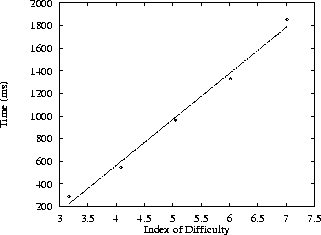
Figure 3: Scatter-plot graph of the MT-ID relationship for the
goal passing task
The recursion, illustrated by Figure 4, is defined as follows:

 , as shown in Fig.
4.b. Since each of the two parts is a task modeled in step
1 with amplitude A/2, it is logical to assume the index of difficulty to move from goal 1 to
goal 3 via goal 2 is:
, as shown in Fig.
4.b. Since each of the two parts is a task modeled in step
1 with amplitude A/2, it is logical to assume the index of difficulty to move from goal 1 to
goal 3 via goal 2 is:

 step divides the amplitude A
into N identical amplitudes
step divides the amplitude A
into N identical amplitudes  , as shown in
Fig. 4.c. The difficulty to move from goal 1 to
goal N+1 via goals 2, 3, ..., N is:
, as shown in
Fig. 4.c. The difficulty to move from goal 1 to
goal N+1 via goals 2, 3, ..., N is:

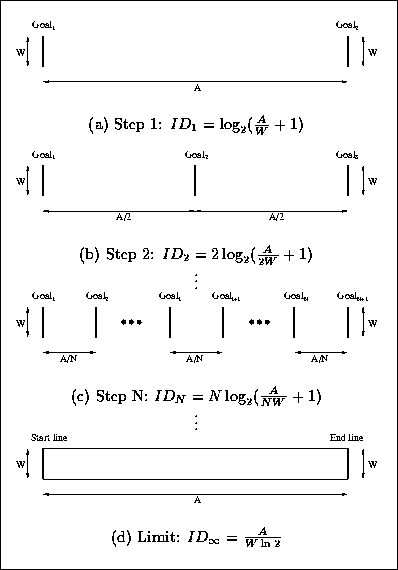
Figure 4: Defining a recursion with goal passing tasks
This recursion is interesting because of the increasing constraint it imposes onto movements:
the bigger N is, the more careful the subject has to be in order to pass through all
goals. If N tends to infinity, the task becomes a ``tunnel traveling'' task. The tunnel
has length of A and width of W. (Figure 4.d). It is also possible to determine the index of difficulty
for the limit task by determining the limit of the index of difficulty recursion
 . Indeed, using a first order Taylor series
expansion of
. Indeed, using a first order Taylor series
expansion of  , we obtain:

Therefore, such an analysis predicts
that the difficulty to achieve this tunnel traveling task is not related to the logarithm of
but to . This
leads to equation 2:
where a and b are empirically determined constants. In the following,
 is defined as
instead of
is defined as
instead of
 for simplicity.
In order to verify these assumptions, we ran an experiment corresponding to Figure 4.d.
At the beginning of each trial, only the rectangle, as presented by Figure 4.d, was presented on the screen, in green color. Pressing on the stylus tip resulted in a blue line being drawn. The line color then turned red when the cursor crossed the left side of the rectangle, and both the rectangle and the line turned yellow when the task ended, as the stylus crosses the right side of the rectangle. A beep was also emitted when changing conditions. The crossing of the left and right sides of the rectangle was taken into account only if proceeded from left to right. Crossing the ``sideways'' of the path results in the cancelation of the trial and an error being recorded.

The error rate increases significantly when the task becomes very difficult; the average error rate is 6.4%.

Figure 5: Scatter-plot of the MT-ID relationship. The relation fitted was
 where
where

Note that, although subjects were asked to minimize errors in this experiment, the error rates are considerably higher than those typically found in Fitts' law studies 2. Steering through a very narrow tunnel without going out of the boundaries at any point of the trial is much more difficult than tapping on small targets. Modeling error rate as a function of task difficulty should be conducted in future studies.
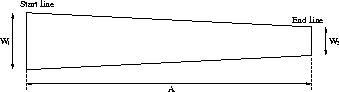
Figure 6: Narrowing tunnel
Such a task can also be decomposed into a set of elemental goal passing tasks, for which we can calculate the index of difficulty. But this method and the resulting expression of the index of difficulty (an infinite sum) is somewhat complicated compared to the simplicity of the tunnel shape. We thus applied a new, simpler method to compute the index of difficulty for this task.
The new approach considers the narrowing tunnel steering task as a sum of elemental linear steering tasks described in experiment 2. Figure 7 shows such a decomposition.

Figure 7: Decomposition of the narrowing tunnel
Let us consider an elementary path of this decomposition, situated at abscissa x and of
length dx. The index of difficulty for steering this elementary path, noted
 , is, according to Experiment 2,
 , where W(x) is the width of the
path at x. To obtain the ID of the entire path, we just have to sum all
along the path, that gives:
, where W(x) is the width of the
path at x. To obtain the ID of the entire path, we just have to sum all
along the path, that gives:

so that the index of difficulty for the narrowing tunnel is:

Moreover, it is possible to prove that decomposing a steering task into elementary steering tasks or into elementary goal passing tasks are equivalent methods, resulting in the same IDs. One can thus choose the most convenient method, depending on the shape of the path.
 = 20, 30, 40, 50;
 = 8; A = 250, 500, 750, 1000.

Due to the high constraint on the right end of the tunnel, high error rate occurred in all conditions. The average error rate is close to 18%.

Figure 8: Scatter-plot of the MT-ID relationship for the narrowing tunnel
task

Figure 9: Integrating along a curve
To establish a generic formula, we introduced the curvilinear abscissa as the integration
variable: if  is a curved path, we define the index
of difficulty for steering through this path as the sum along the curve of the elementary
indexes of difficulty. We thus obtain the generic expression of
is a curved path, we define the index
of difficulty for steering through this path as the sum along the curve of the elementary
indexes of difficulty. We thus obtain the generic expression of
 :
:

Our hypothesis was then that the time to steer through
is linearly related to , that is:
where a and b are constants. This formula is a generalization of the cases presented earlier, which can be deduced from it. As an example, let us consider the horizontal steering task corresponding to experiment 2. In this case, W(s) is constant and equal to W, so that equation 5 gives:

which is equation 2 found in experiment 2.

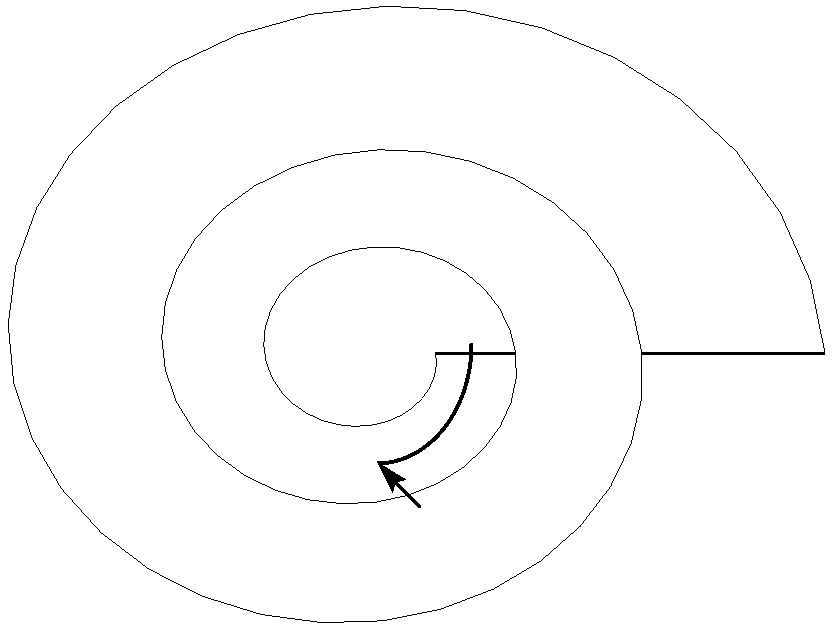
Figure 10:An instance of spiral
We defined a set of spirals  by varying two
parameters: w is the parameter influencing the increase of the width of the spiral;
n stands for the number of ``turns'' of the spiral. Figure
10 shows an example of such a spiral,
by varying two
parameters: w is the parameter influencing the increase of the width of the spiral;
n stands for the number of ``turns'' of the spiral. Figure
10 shows an example of such a spiral,
 .
.
The equation of  in polar coordinates is:

This set of spirals has been chosen to guarantee that the width of the path will vary significantly.
Our goal here is to predict the difficulty for steering these spirals. To apply the previous
method, we must determine both the curvilinear abscissa function of
 and the width of the path for
any .
and the width of the path for
any .
A good approximation for the width of the path for a given angle
is:

and it can be proven that:

We can then apply Equation 4 and make a summation of elementary IDs, and obtain:
The procedure was similar to the previous experiment. At the beginning of each trial, a spiral, as illustrated in Figure 10, was presented on the screen. The task starts when the cursor crosses the inner small segment, and ends as the stylus crosses the outer long segment, after completing the spiral steering. Crossing the spiral boundary results in the trial being canceled.

The average error rate for this task is 13.7%.

Figure 11: Spiral steering
where v(s) is the velocity of the limb at the point of curvilinear abscissa
s, W(s) is the width of the path at the same point and  is an empirically
determined time constant. This local law predicts that the instantaneous speed of steering
movement at any point is proportional to the variability permitted, i.e., the width of the path
at this point.
is an empirically
determined time constant. This local law predicts that the instantaneous speed of steering
movement at any point is proportional to the variability permitted, i.e., the width of the path
at this point.
The justification of this relationship between velocity and path width comes from the
calculation of the time  needed to steer through
a path . Indeed, along the path, the velocity v
is defined as
needed to steer through
a path . Indeed, along the path, the velocity v
is defined as  , so that
  and, considering the local law above:

This latter expression of is very close to
equation 5. Indeed,
the intercepts observed with real data of experiment 2 (-188 ms), experiment 3 (-532
ms), and experiment 4 (115 ms) are relatively small compared to the total trial
times. It probably came from any random variation of subject performance. Ideally, the
intercept should be null, but equation 5 includes it
to take these variations into account.
In order to check the validity of equation 7, we used the data from previous experiments and plotted speed versus path width to check the linear relationship.
For experiment 2, for each of the eight widths of this experiment, we calculated the average speed of steering. Figure 12 represents the resulting scatter plot. The graph, built from about 120000 move events (events received from the X server), shows the linear relationship between the path width and the stylus speed. Excluding the last two points (justification in discussion section), we found that:

The small intercept can be neglected, which is coherent with equation 7. We can then derive that  .
.

Figure 12: Speed vs. path width for experiment 2
For experiment 3 and 4, as the width is not constant, we can directly extract the average speed for any given path width. Figures 13 and 14 present respectively the scatter-plot of speed vs. path width in the cases of narrowing and spiral tunnel steering (respectively based on about 150000 and 200000 move events). These graphs also show a linear relationship between path width and hand speed. For the narrowing tunnel, considering only path widths that are less than 35 pixels, we found that:

In the case of the narrowing tunnel, is thus close
to 70 ms.
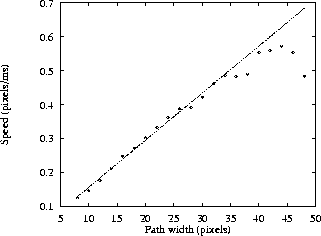
Figure 13: Speed vs. path width for experiment 3
For spiral steering, considering only path widths that are less than 80 pixels, we found:

from which we can deduce that is close to
110 ms.

Figure 14: Speed vs. path width for experiment 4
First, due to human body limitations (speed, acceleration), there are upper bound limits to the path width that can be correctly modeled by the these simple laws. Exceeding these limits leads to the saturation of the laws described above. These limitations are the reason why we had to remove the greatest widths when analyzing linear relationships between speed and path width for the local law.
Second, the local law can be modified to take path curvature into account. Indeed, our local
law could be compared to the law introduced by Viviani et al. [16], who argued that tangential velocity v and radius of
curvature  are proportional in unconstrained
movements 3. We hypothesize that a more
general steering law should be:
are proportional in unconstrained
movements 3. We hypothesize that a more
general steering law should be:

Finally, the starting position clearly influences the difficulty of a steering task. For instance, the performance likely depends, in Experiment 1, 2, and 3, on whether steering is performed from left to right or from right to left, and in experiment 4, on both the centripetal / centrifugal and clockwise / counter clockwise directions of steering. Steering is then probably related to handedness.

Figure 15: Interacting with menus
Selecting an item in a hierarchical menu involves two (or more) linear path steering tasks: a
vertical steering to select a parent item, followed by a horizontal steering to select a
sub-item. Applying the results from experiment 2, we can model the time to select a sub-menu as
the sum of the vertical and horizontal steering tasks. If
 stands for the time needed to select the
  sub-menu (Fig. 15),
we obtain4:
sub-menu (Fig. 15),
we obtain4:

From this equation, we can deduce that is minimal
when  , that is
 . Therefore, assuming that n
is, on average, half the number of items in the menu, the greater the number of items is, the
greater the quotient
. Therefore, assuming that n
is, on average, half the number of items in the menu, the greater the number of items is, the
greater the quotient  should be.
This study may also be used as a means to compare designs, such as modeling the difference between linear hierarchic menus and hierarchic pie menus [10], for example. More generally, this is a step in the modeling of marking-based interaction and the evaluation of marking interfaces.
in equation
7, can be used as indexes for performance comparisons.
Device [3, 12] and
limb [4, 11]
comparisons have been done with Fitts' Index of Performance in pointing tasks. b and
in the
steering laws will allow us to quantify performance in trajectory-based tasks, as a function of
different devices, a function of different body limbs, or a function of any design parameter
changes such as control gain and transfer function. By applying the steering law, we plan to
study performance differences among various input devices such as mouse, stylus, isometric
joystick, and trackball.
The regularities presented in this study may enrich our tool kit in conducting HCI research and design. Device comparison and menu design are just two of the many potential HCI applications.
This research was undertaken under the auspices of the Input Research Group of the University of Toronto, directed by Bill Buxton who has made substantial contributions to the development of this paper. The work was supported by the Centre d'Étude de la Navigation Aérienne (CENA), the Information Technology Research Center of Ontario (ITRC), Alias|Wavefront Inc., the Natural Sciences and Engineering Research Council of Canada (NSERC), and the IBM Almaden Research Center. We are indebted to the members of the IRG group for their input. We would also like to thank Wacom Corporation Inc. for their contributions to the project. We particularly like to thank Thomas Baudel of Alias|Wavefront, Stéphane Chatty of the CENA, and William Hunt of the University of Toronto for their helpful comments on the project.
|
|