CHI 97 Electronic Publications: Demonstrations
Access for all: HEPHAISTOS - A Personal Home Assistant
Michael Burmester, Joachim Machate, Jochen Klein
Fraunhofer IAO
D-70569 Stuttgart, Germany
+49 711 970 2312
Joachim.Machate@iao.fhg.de
ABSTRACT
In this paper, we describe a demonstrator which was developed in the course of
the European project TIDE 1004: HEPHAISTOS (Home Environment Private Help AssISTant
fOr elderly and diSabled). The demonstrator constitutes a hand held personal home
assistant capable to control a selected range of electronic home devices. Its multimodal
user interface is based on a coloured high resolution touch screen extended with speech
input/output. The development process focused on taking into account requirements of
elderly people and people with special needs. The usability of the personal assistant
was evaluated in a series of user tests with subjects from this particular demographic
groups.
Keywords
Personal home assistant, customer electronics, touch sensitive control, speech recognition,
user interface design, dialogue elements, PSN-elderly, design for all.
© 1997 Copyright on this material is held by the authors.
INTRODUCTION
It is a common view that we are currently living in an information age. People are confronted
with electronic user interfaces in various kinds. Information in electronic form appears nearly
anywhere, starting from ticket sales machines or self-banking automata to the panels of washing
machines or many other kinds of electronic home equipment. It is no new insight that with this
increase of information sources the accessibility and the usability of the related devices suffer.
Furthermore, it is also no new insight that especially elderly people and people with special
needs are often hindered to gain access to this new media world by the complexity and difficulty
of use of their interfaces. A European project consortium gathered from different consumer
electronic companies and academic institutions started a two years project called HEPHAISTOS
(Home Environment Private Help AssISTant fOr elderly and diSabled) which aimed at the construction
of a hand held personal assistant that puts it�s potential user in the position to control
a wide range of electronic home products via one consistent and easy-to-use interface.
DESIGN FOR ALL
Despite the fact that in the middle of the 21st century the proportion of elderly people
(people aged more than 50 years) will be bigger than the proportion of younger people and
the fact that till the year 2020 the proportion of people older than 65 years will reach
20% of the European population [5], few efforts are undertaken to meet their specific
requirements with respect to the usage of electronic home devices. In addition and often
underestimated, the population of people with special needs amounts to 13% of the overall
European population [2]. In order to use modern home equipment, this particular group often
relies on the availability of specifically adapted control devices. It is a main goal of
HEPHAISTOS to overcome this situation and to develop and demonstrate a unique personal
assistant which provides multimodal access to a broad range of electronic home devices.
Multimodality with regard to the HEPHAISTOS assistant means to enable access to any
electronic home device via different communication channels. Besides a conventional palm
top like remote control with touch sensitive input, the control unit is enhanced with speech
recognition capabilities and with audio facilities with which the interface can be explained
to the user (see Figure 1).
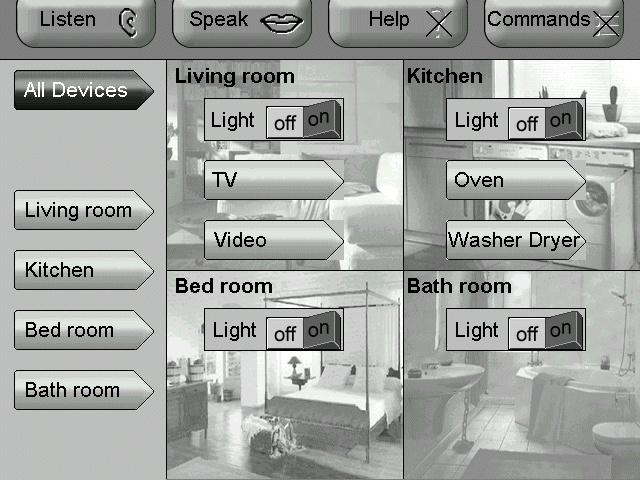
Figure 1. The main screen of HEPHAISTOS
Although taking into account primarily requirements and expectations uttered by elderly people
and people with special needs who participated in the user trials, it is an essential hypothesis
of the project consortium that HEPHAISTOS not only can be used easily by average people but
also will be appealing to a larger majority through it's aesthetic look and feel.
THE HEPHAISTOS APPROACH
Starting from the results of the FACE project (Familiarity Achieved through Common User Interface
Elements), a project funded by the ESPRIT research programme of the European Community, the design
of the HEPHAISTOS demonstrator was based on a set of generic interface concepts, e.g. use of
scales for parameter setting, single and multiple selection methods, or setting of clock and
date [4].
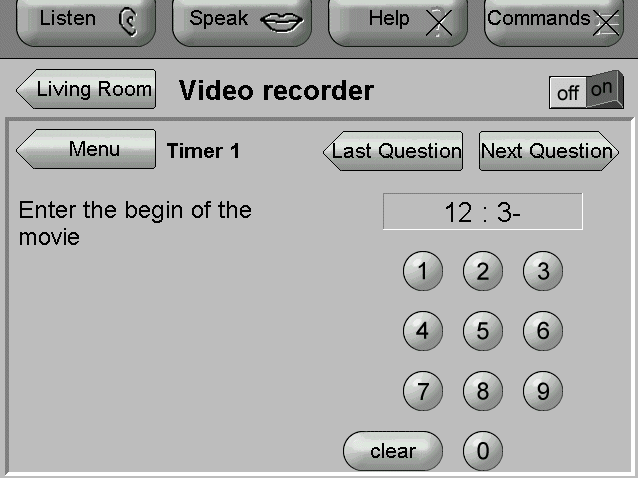
Figure 2. Time setting at the VCR panel of HEPHAISTOS
The development process was implemented as an iterative cycle running through four phases, namely
analysis, design, simulation and evaluation. Object-oriented development methods and design methods
for customer electronics user interfaces as described in [1,6,7] were adapted.
THE HEPHAISTOS DEMONSTRATOR
Whereas the simulations used for a first set of user trials consisted of a software solution solely,
the final HEPHAISTOS demonstrator constitutes a touch sensitive palm top remotely controlling real
devices which were connected via a home bus. A washing machine, an oven, a TV, a VCR and a lamp were
chosen as representatives for the various electronic home equipment found in an average household.
USER TRIALS
The project established two test sites. The National Institute for Rehabilitation of the Handicapped
in Athens, Greece carried out trials with people impaired by speech, reading, upper and lower limb
co-ordination or movement, and restricted concentration span. The University of Stuttgart IAT,
Germany, carried out trials with elderly people aged from 64 to 84 years. A description of the first
results can be found in [3].
THE FUTURE
The project finished successfully in Dec. 1996. As a result, the HEPHAISTOS demonstrator is installed
and available for further examinations in some of the partners laboratories. The project consortium
is happy to announce that the achievements of HEPHAISTOS will be broadened in a new project called
HOME which is also funded by the EC and which has started in January 1997. As major enhancements of
HEPHAISTOS, HOME will integrate gesture recognition and free speech, which means that it will no
longer be necessary to have a microphone installed in the assistant. With these prospects the
consortium feels well prepared to enable the envisaged target groups to really get access to the
electronic world and to contribute to a design for all philosophy.
ACKNOWLEDGMENTS
The authors wish to thank the HEPHAISTOS consortium for the chance to expose the project results to
a larger international audience.
Design of graphical elements by Ruth Diessl, Fraunhofer IAO, Stuttgart.
REFERENCES
1. Beck, A., Janssen, C., Weisbecker, A. and Ziegler, J. Integrating Object-Oriented and Graphical
User Interface Design. Proceedings of the SE/HCI Workshop, Sorrento, Italy, May 16-17, 1994.
2. Botella, V. and Waldmeyer, M.T.A. Identification and grouping of Special Needs of PSN-Elderly
with respect to User Interface Design. Deliverable 2, TIDE 1004 HEPHAISTOS, 1995
3. Burmester, M. and Fähnrich, K.P. HEPHAISTOS - A Multimodal Help Assistant for the Home Environment.
In A.F. Özok and G. Salvendy (eds.): Advances in Applied Ergonomics, Proceedings of the 1st Int. Conf.
On Applied Ergonomics (ICAE '96), Istanbul, Turkey: West Lafayette, 238-243, 1996.
4. Burmester, M. and Machate, J. "Common User Access" for Electronic Home Devices or 20 Ways to
Set the Clock? In R. Oppermann, S. Bagnara and D. Benyon (eds.): ECCE7 Seventh European Conference
on Cognitive Ergonomics. Human-Computer Interaction: From Individuals to Groups in Work, Leisure,
and Everyday Life. Proceedings. GMD-Studien Nr. 233. Sankt Augustin, Germany, 97-110, 1994.
5. Dall, J.L.C. The Demography of Europe. In H. Bouma and J.A.M. Graafmans (eds.): Gerontechnology,
Amsterdam: IOS Press, 31-38, 1992.
6. Görner, C. Vorgehenssystematik zum Prototyping graphisch-interaktiver Audio/Video Schnittstellen.
IPA-IAO Forschung und Praxis 194, Berlin: Springer, 1994, in German.
7. Sanz, M., Gómez, E.J., del Pozo, F. e.a. Metodología de Diseno de Interfaces de Usatio Gráficas.
Jornadas Técnicas del Proyecto TEMA. Telefónica Investigación y Desarrollo, Madrid, 1994, in Spanish.
CHI 97 Electronic Publications: Demonstrations