CHI 97 Electronic Publications: Demonstrations
Demonstration and Guided Tours of Virtual Worlds on the Internet
Bruce Damer
Contact Consortium
P.O. Box 66866
Scotts Valley, California 95067-6866 USA
Tel: +1-408-338-9400
E-mail: bdamer@ccon.org
ABSTRACT
Multi-user virtual worlds are proliferating on the Internet. These
are two and three dimensional graphical environments inhabited
by users represented as digital actors called "avatars".
Through this medium, a wide variety of Internet users are participating
in a large scale social experiment and collaborating on a variety
of projects. The inhabited virtual world is an exciting new medium
for HCI professionals including interaction and graphic designers,
and educators and researchers focused on distance learning and
teleworking. It also appeals to children and ordinary users of
the Internet as a vast new digital playground and a venue for
personal expression. This demonstration will introduce participants
to a variety of inhabited virtual worlds and give them hands-on
experience in collaboratively building and interacting with other
users in the worlds.
Keywords
virtual worlds, social computing, avatars, collaborative workspaces,
VRML, three dimensional interfaces
© 1997 Copyright on this material is held by the authors.
INTRODUCTION
For the past two years, the Internet has played host to a new
medium: the multi-user virtual world. These environments are
graphically rendered in two or three dimensions and represent
the presence of participants as digital characters known as "avatars".
Participants navigate their avatars through these digital spaces,
communicate with other users, build structures, teach, learn,
and engage in a variety of collaborative activities. On-line virtual
worlds represent an new frontier for interaction design, computer
supported cooperative work and learning and touch upon many other
interest areas of HCI.
This demonstration will introduce HCI professionals and novice
users alike to the medium of multi-user virtual worlds. No prior
knowledge of 3D modeling, VRML or online communication is required.
Origins of the virtual worlds medium
This technology could be seen as
a graphical extension of MUD and MOO environments but it exhibits
some of its own unique characteristics, including:
- Social environments exhibiting properties of a culture
- Collaborative construction of
large scale spaces including buildings and full towns, artwork,
areas containing digital biota and soundscapes
Virtual worlds borrow from both the
virtual reality and computer gaming field. However, this medium
does not require the kind of immersive equipment (such as head
mounted displays) found in virtual reality systems. In addition,
virtual worlds employ fast 3-D graphic rendering engines found
in gaming environments but their application is almost purely
social.
THE VIRTUAL WORLDS TO BE USED
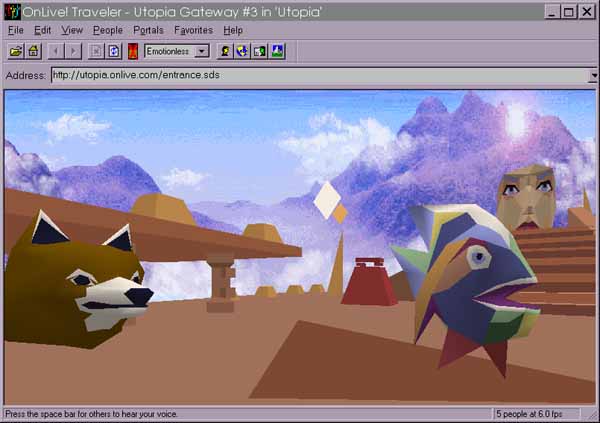
Figure
1. Scene from Onlive Traveler showing users represented
as avatars communicating through voice.
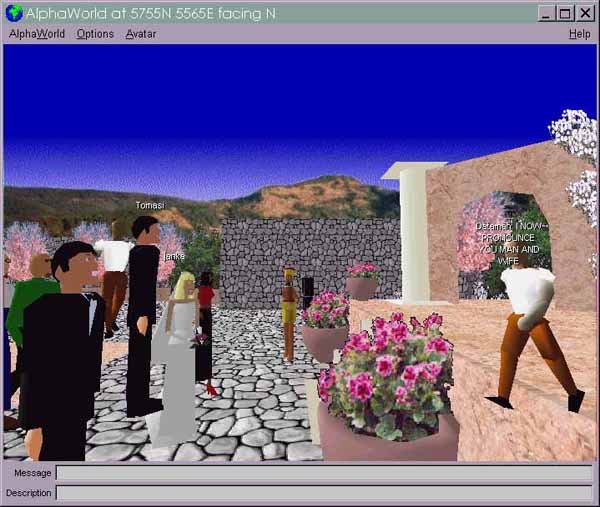
Figure
2. Scene from AlphaWorld showing users participating
in a virtual wedding.
The demonstration will illuminate several virtual world environments,
including: Onlive Traveler (see Figure 1), AlphaWorld (see Figure
2), CyberHub, the Palace, Virtual Places, WorldsAway, general
VRML 2.0 environments and others which become available by the
time of the demonstration. The Virtual University server within
AlphaWorld will be made available for the demonstration.
GOALS OF THE DEMONSTRATION
The learning objective of the demonstration
is to give participants enough background and hands-on experience
of this new medium that they can use on-line inhabited virtual
worlds in their research or professional projects. It is our hope
that the demonstration will also encourage more HCI professionals
to participate in the development of the virtual worlds medium.
DEMONSTRATION EXERCISES
Along with a larger demonstration, scheduled time periods will
feature guided tours of several virtual environments. The tours
will illustrate key issues in 3-D interfaces, virtual community,
cooperative and participatory interaction design, usability
testing, teleworking, CSCW and CSCL, the World Wide Web and Internet
social issues.
Demonstrators will help tour participants learn how to navigate,
communicate and build within virtual worlds, including AlphaWorld,
CyberHub, WorldsAway, Onlive Traveler and others as they become
available closer to the conference date.
DEMONSTRATION PRESENTERS
Demonstrators will include members of the Contact Consortium,
a non-profit research membership organization dedicated to the
development of the virtual worlds medium. Throughout 1995 and
1996, the Consortium has engaged in extensive usability testing
of virtual worlds provided by its member companies, which include
Worlds Incorporated, Intel, Black Sun Interactive, Time-Warner
Interactive, Nippon Telephone and Telegraph (Software Division),
Microsoft, Philips and others. The Consortium has engaged in the
collaborative construction and staffing of a virtual town (Sherwood
Forest), a virtual university (TheU) and has hosted in regular
social experiments in these online worlds.
Other participants will join us from around the world as avatars
in-world to assist with questions and answers and the guided tour
demonstrations themselves.
REFERENCES
User experiences in design and collaboration through the virtual
world medium are extensively documented on the World Wide Web
at http://www.ccon.org.
CHI 97 Electronic Publications: Demonstrations