


|
|
Due to the rapid development of information and multimedia technology, the information and services available within a Public Library are changing. This design project, executed by Philips Corporate Design in cooperation with the Public Library of Eindhoven, approached the library not as a digital catalogue but as the center of a community, a place to gather, communicate with others, and a place to obtain and exchange information with anybody about anything. Library (non)-users investigations provided information regarding the current state and perception of the library, the catalogue, as well as to desired improvements, services and tools. The design process and the initial designs of these services and tools are presented.
The rapid evolution of communication and computer technology has meant a large increase in the type and the amount of information available. More cost effective, real time, multimedia communication using extensive computer power is replacing the traditional forms of communication and information use. These trends clearly confront the general public with many new opportunities to access and interact with information. These trends are also raising major questions about which organizations are the key suppliers of information in the public domain, and what are the associated boundaries in relation to ownership and commercial value.
The institution of the public library has been providing information for education and entertainment for decades. People with varied interest and different social backgrounds have gathered for years to find items that will feed and satisfy their interests, to meet other people, or to simply browse through endless rows of books, newspapers, and magazines.
The emerging technologies and the possibilities for new services and new forms of information confront public libraries with many significant questions about how their social role will evolve, the scope of services to be offered, their position in relation to other suppliers in both the traditional and emerging areas. The library is ideally placed to do so as it is recognized by the public as an information provider. In providing its current members access to this new digital information will attract new members who at present see it as an out of date public service that provides "just books." As part of the service the public library should aim to educate its members how to make best use of this technology and show them that the information available is useful and relevant to their needs.
The new city library may expand its traditional function as the social center of information by providing the public with a easily accessible door to the rapidly evolving world of electronic information, electronic communities, and digital technology. That is, the library may provide a large step towards being the center of the information rich community by reducing the gap between the information rich and the information poor; those who can and those who can not afford and/or understand the new technologies. It may maintain the pleasant, social, and convenient atmosphere of the "old" city library as well as provide advance service and communication of a multimedia information center that contains and delivers information in a pleasant communicative manner independent of time and the location of the requester.
Philips Corporate Design and Philips Media cooperated with the Public Library of Eindhoven to investigate possible improvements to the services offered by the public library that would be enabled by the introduction of "multimedia technologies". The design process and its main results are presented in this paper.
The "Library project" focused on the enhancement of the following service areas:
Within the "initiation phase" a project team consisting of the design disciplines available within Philips Corporate Design was formed; people with a background in human factors engineering, anthropology, psychology, interaction-, graphics- sound-, and product design became familiar with the public library and the initial project goals.
During the "analysis" phase, the present library system was evaluated in detail. First, the stepping stones for "getting to know the system", the library, its (non)-users as well as personnel were identified. In addition, relevant literature and other library institutions were studied. The project team investigated the present needs and desires of the (potential) library users and personnel, related their needs to the tools and services that exist today. A questionnaire survey was conducted among 250 users and 125 non-users of the public library within Eindhoven to obtain more relevant data, i.e., socio-economic background, frequency of library use, how, why, order of use, etc. In-depth interviews were conducted with multiple users [3, 6].
In the "concept" phase, the team developed product concepts that would improve the existing library facilities, services, and procedures. These concepts were "finalized" and "evaluated" within a design workshop as well as by library users and personnel with respect to their proposed functionality. Reference groups of six library users and seven library personnel were formed to help define, design and develop the concepts and their desired functionality, looks, and interaction within the tools.
Through several iterations, the tools and their functionality were evaluated and improved towards the needs and desires of the (potential) users. At the end of the "evaluation", a brochure was designed and published.
Within a team of several different and overlapping disciplines, it is difficult to perceive these process phases as "discrete." In a project as complex as this one it was often difficult for team members to keep a balanced view on the total concept, as well as discussing details, without sometimes confusion and conflicts arising. The project work program was made up of frequent workshops, group discussions etc. at various levels of formality and informality. As a conscious part of this process we incorporated the idea of using reference groups (users and library personnel). The direct and frequent communication with the reference groups, library users and personnel, helped the team in obtaining confidence and setting priorities regarding the development of the concepts. This communication was especially important in the design and development of the specifications of the more complex tools.
The word "Public" Library reflects the general user(s) we had to incorporate within any design decisions. (S)he can be described as " a member of the general public with an interest in written, auditory, or visual information for entertainment, knowledge or educational purposes". In addition, (s)he uses the library building as a location of communication, social interaction and comfort. Interaction between the library and its users may occur by using the Public Library's equipment (i.e., catalogue and thesaurus), browsing through the items, talking to library personnel, and by conversing with other visitors. Frequency of use, the complexity of the arrangement, and degree of computer experience helps in the classification of users with regard to the mental models of information organizations they are used to.
Library services provided by the library personnel can be divided among several areas of interests. Identification and registration of library members, the financial administration of the public library, the organization of children support groups, educational groups, promotional activities, information and educational events for foreign nationals.
Within the Public Library several processes were identified. The major processes we described within several scenarios; for example, the process of a person visiting the Public Library, finding something of their interest, and leaving the library with a selected item. With the use of these multiple scenarios, the important aspects within the library processes were identified. As depicted within Figure 1, the identification of the content, its accessibility, and the checking-out procedure are its main operational parts. After entering the library building, and returning previously borrowed items, one may use the electronic catalogue to verify if any items of interest exist and are available, searching and browsing, or directly walk to the location where the particular items are located. With the help of signs and other routing schemes displayed among book cases, tables, and other furniture, the library visitor is guided to the selected location. The user can browse through the information of the selected item if the item is located at its dedicated place. In addition, the user can browse through items of the same subject located within the area. After reviewing the items, the user selects what (s)he likes best, registers the item to her/his account and leaves the building.
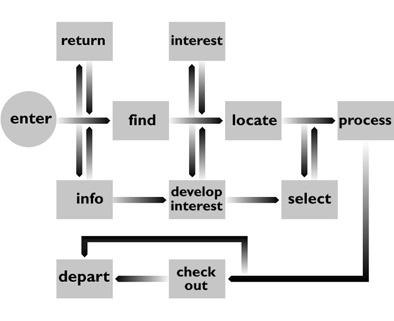
Figure 1. The operational process within the library
Browsing, searching, and reviewing are the major processes performed within the library itself. Browsing is performed by almost 90% of the visitors to the Public Library of Eindhoven. It is currently done by walking by items stored within their respective storage cabinets, i.e., books in the bookcases, CDs in musical racks, magazines in display cases, and newspapers on reading tables. In addition, browsing can be accomplished by "direct searching" using the catalogue application that is available on designated terminals. Browsing is limited by the amount of space that is available and the effort that is required to walk among the items; walking around the sections with your head at an angle in order to read the titles of books is not a great way to browse. Browsing is successful when one arrives at a section or item of interest. While a user browses, their needs and wishes are becoming better defined until they are met when specific item(s) of interest are found and located. A person browses to obtain an overview of what is available and how it relates to its surrounding. While browsing the user may use a combination of four strategies: scanning, observing, navigating, and monitoring. Browsing is especially suitable for when the information criteria are ill defined and when one wants to obtain an overview about a topic or field of interest [4]. An essential item within a browsing application is a defined entry point that indicates to the user what the information represents as well as provides the user with specific cues about the organization and structure of the information system In addition, the user needs to be able to examine and access the displayed information while browsing. An entertaining, informative, and easily accessible environment is recommended.
Searching is an information retrieval task in which the items of interest or the interest is defined but where the specified item(s) still need to be identified and located. Search applications available within the present library require the user to provide names of subjects, titles, or author. The feedback provided is a list of items that are available or, if the response is large, a number of sub-categories in which the user has to select one�s preference. A reference location with the ability to make personal notations, structure information, and easy storage and retrieval is recommended.
Reviewing occurs when the items have been retrieved and the user needs to go through the material in some more detail. Reviewing may take some time and is more "reading for comprehension" intensive than the aforementioned processes. A more quiet location with "personal space" is necessary for this process. In addition, easy access to the search tools to obtain more information close to or within the "personal space" is recommended.
People have had problems searching and retrieving information within on-line catalogues and bibliographic-retrieval systems for a long time. Borgman [2] in her research on information retrieval studies identified that those difficulties may arise from the user-system interaction, where she made a distinction between knowledge of the mechanical aspects of searching, the ability to use the system at a threshold level, knowledge of the conceptual aspects, and the ability to exploit the system. Standardisation of command languages and screen displays and the development of logical microcomputer bases front ends were some of her suggested solutions to the problems. Within the last five years more and more attention is focused on information visualization research from a users� perspective. Rapidly adjustable "dynamic" query filters, tight coupling of data output-input relationships, and instant display of results within "starfield displays" are concepts introduced to enhance the search for information [1].
From the initial interviews with library users and non-users and the reference group the library system requirements were determined. Input and feedback from the employees of the Public Library of Eindhoven was obtained through interviews as well as through extensive discussions with representatives of seven departments; inter-library loan, library information, exchange, music, youth, ordering & reservation & catalogue, and general operations. The user requirements were evaluated and used as the design requirements of the project. Some of the important ones are noted below:
General
Collection - Catalogue
Support
Through our research into user's needs and wants, we were better able to understand how people use the library and we were in a better position to describe the various activities users engage in. What emerged clearly from early research was that users perform various activities in different parts of the library. The places where those activities are performed are linked to where the various parts of the library�s collection are located around the building.
Access to the library catalogue and the services needs to be through a range of tools designed to support the particular ways a user will want to use the library. So different needs are served by different tools, but at the same time the tools form a coherent whole. As a user will go from one tool to another he or she is will not be confronted with completely different devices. What users will learn using one tool will help them to use another. The tools will also be inter-linked. When information is entered into one tool, it will be recognized by the whole system. The user will not have to repeatedly enter the same information.
The results of the user studies were described within three key findings;
The heart of the public library is its collection; the content, the books on the shelves, the CD's, the video tapes. This is the store house of information that people come to use. The collection is described in the catalogue. Users confront the catalogue in different forms; by walking by the items, using the card index and by computer terminals.
Central to the whole design concept, therefore is the question how to redesign the catalogue in such a manner that the way users access the information is more finely tuned to their task, and the catalogue caters for the rapidly emerging world of computer based multimedia information. In addition, it needed to comply with SISO, the standard information organizational structure used in the Netherlands [5].
The following design principles and goals were formulated for the project with a primary focus on enhancing the catalogue.
Some of the main problems identified throughout the design process were:
The requirements of the public library users and library personnel were translated into tools. The smart card, library guide (map), reading table, search and browsing tools are all concepts that are designed with an emphasis on personalisation, spatial linking, and visual quality. Together, they formed the design challenges of this project and together they provide all the necessary support to the public library user in his quest for more suitable interests and supporting items (see Figure 2).
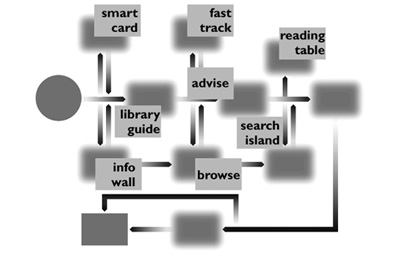
Figure 2. The new service-oriented operational process within the public library mapped on the process of use
The following concepts and tools were developed:
Users will be able to return books and other borrowed items without entering the public library itself. There will be an information point providing information about the library's services and facilities.
People first come into contact with the public library in the town center, then in the street near the library building, and finally within the building itself. The entrance hall of the public library provides to the user information of all public library activities.
A wall of images and sound that displays information in a dynamic, attractive and entertaining way. Users can just watch and listen but can also interact with it to get at the information they want (see Figure 3). It is used to display information about special events, recent additions to the catalogue, particular topics that the public library wants to advertise and so on. It is located in different positions within the library itself, but also in other parts of the city.

Figure 3. The Infowall
When users return items, they can classify them as "recommend" to other users, "add" to personal profile, or "return". Items classified as "Recommend" are added to the recommendation lists of those who are interested in that subject. "Add" may be accessed by the user for later reference, and the other items are returned without further processing.
The Smart card contains information relating to the users particular areas of interest and acts as a key to all the tools and services within the public library. By storing personal profiles and a transaction history on a Smart card the system can link individual preferences with categories of interest and connect this with others who have the same interest.
An interactive guide that provides information about the specific services the public library has to offer, how to make use of them, where they are located and how to get there. It also tells the user who they need to see for help.
Innovative hyper link technology that enable users to explore the catalogue in a 3-dimensional manner in ways which reflect their own interests. A key feature is that users are prompted to explore areas of the catalogue which they might otherwise have never known existed (see Figure 4).
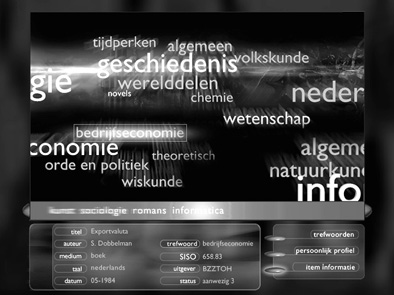
Figure 4. The Browse
An interface to the catalogue is designed to enable those who know just what they want to rapidly identify whether the public library has a copy, where it is, and even make a reservation (see Figure 5).
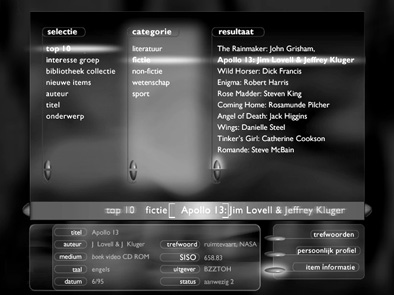
Figure 5. The Fast Track
Extending the use of hyper link technology to help users find specific items related to the subject of interest. More suitable for the user than the Fast-Track when the user does not know exactly what they want. The Search integrates the Browse and the Fast Track; it adds additional capability for those familiar with more flexible retrieval techniques.
Special locations within the public library where users can get access to the basic set of tools; Fast Track, Search, and Browse.
A pleasant and familiar place in the public library that provides access to user groups, Internet, digital magazines, newspapers, and email (see Figure 6).
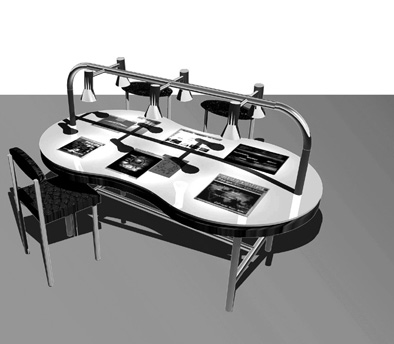
Figure 6. The Reading Table
A key factor to the success of this project is the gradual layered introduction of 'interactivity' with the tools and their location in space. The user is not confronted with a computer on a desk and expected to make use of it. Instead, careful consideration has been given to the levels of functionality delivered with each tool and their envisaged physical location within the library space.
When entering the public library, situated in the reception area the Infowall provides information available to users from a distance where they can decide on their next course of action. If the library users require more general information additional interaction with the Infowall is possible. Further on from the Infowall dedicated tools support multiple options for interacting with the library collection.
Users can approach through the 'Browse' or the 'Fast Track' area, both of which lead users through to the heart of the library collection. The tools located within the "Browse" and "General Information" areas aid the users in defining their interest as well as locating items while the tools within the "Fast Track" area cater to the direct needs of the user (see Figure 7).
Frequent public library users with no specific request may wish to enter the more convivial space of the 'browse area' where they can read magazine's and informally browse the library 'database' of services in comfortable surroundings. The scope and level of interactivity is incrementally increased in this area. As browsing is perceived as a more entertaining pastime the 'interface' is designed to reflect this. The Fast Track area provides easy access to specific requests, as a result the interface is more systematic allowing for a direct 'keyword' search. Within the heart of the library, 'info islands' offer combined 'browse' and 'search' functionality.
The interfaces of the products are developed to attend to all library users, from those that like to browse within the colorful library collection using a simple one-touch button & ball control to the professional searcher that prefers tight coupling of information in his quest for more facts and figures.
Within this project we approached the public library as one system consisting of multiple functionality. The system was evaluated by designers, library employees, and library users as one; from users entering the public library and selecting items to employees providing users with information and returning items to their assigned locations. This "one system" approach was essential to the integration, consistency, and functionality of the library tools (see Figure 7).

Figure 7. Overall view of the entrance of the library
Through our research into user's needs and desires we were better able to understand how people use the public library and we were in a better position to describe the various activities users engage in. What emerged clearly from this research was that users perform various activities in different parts of the library. The places where those activities are performed are linked to where the various parts of the public library's collection are located around the building.
Close collaboration with library staff and library users started at the analysis phase and continued throughout the design process. Their needs, wishes, and desires were obtained during the evaluation of the current library system, provided the goals of the project, and continued to provide direction during the gradual introduction of the new public library and its tools that are now under development. The user investigations provided us with the insight that the catalogue was the heart of the library, that new technology and tools should gradually be introduced within the environment and that the ancient premises of the safe and grandeur environment should be maintained.
Tomorrow's public library system will provide the frame work for an information rich society where individuals are independent of the cost and accessibility of newly developed information and communication technology. The public library, connected to schools, hospitals, and homes, communicating with local and regional support communities and other organizations, will be the center of integrated services designed to provide its user's with the appropriate tools that help them identify, select, and find customized information. It will expand its traditional function as the social center of information by providing the public with a easily accessible door to the rapidly evolving world of electronic information. The public library system also will continue to educate, inform, and entertain its visitors by providing them with the opportunity to search, select, and use any information available within their collection.
Thanks are due to the Public Library of Eindhoven, Henk Das, Jos Geevers, our fellow team members of the Library Project, DC3 design consultancy, and the public library users and non-users of the City of Eindhoven, the Netherlands. The authors would also like to thank Andrew Baxter, Jeanne de Bont, Anita Heister, Ilse van de Hurk and Govert de Vries for their help on the project and for reviewing the paper.
|
|